
🤝 Top Collaborators

🤓 Latest Submissions
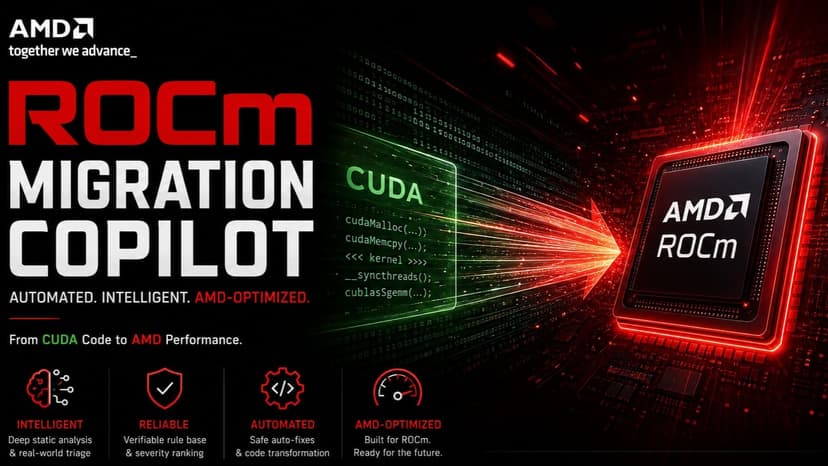
ROCm Migration Copilot: CUDA-to-ROCm Triage
Migrating a PyTorch or Hugging Face training pipeline to AMD ROCm hardware is harder than it should be — not because of missing documentation, but because the friction lives in a layer nobody currently owns. AMD's own HIPIFY tool translates CUDA/C++ kernel code excellently, but most ML engineers never touch a .cu file; they write device="cuda", import bitsandbytes, and call flash_attn without knowing which of those choices will silently fail or degrade on ROCm. ROCm Migration Copilot closes that gap. It statically scans Python training scripts using libcst, matches code against a versioned, sourced rule base covering constructs like hardcoded CUDA device strings, NCCL backend calls, and known-unsupported libraries (bitsandbytes, Flash-Attention, AWQ), and produces a severity-ranked report — distinguishing issues that can be safely auto-fixed from ones that need a human engineer's judgment. Rather than asking a generic LLM to blindly rewrite CUDA code (which hallucinates fixes against a support matrix it doesn't actually know), we put a deterministic, cited rule engine in front of the model, so every flagged issue is traceable to a real source, not a guess. Built for the AMD Developer Hackathon, targeting real Hugging Face training scripts as test cases, with a CLI-first workflow suited for CI pipelines and pre-migration audits alike.
13 Jul 2026


