
🤝 Top Collaborators

🤓 Latest Submissions
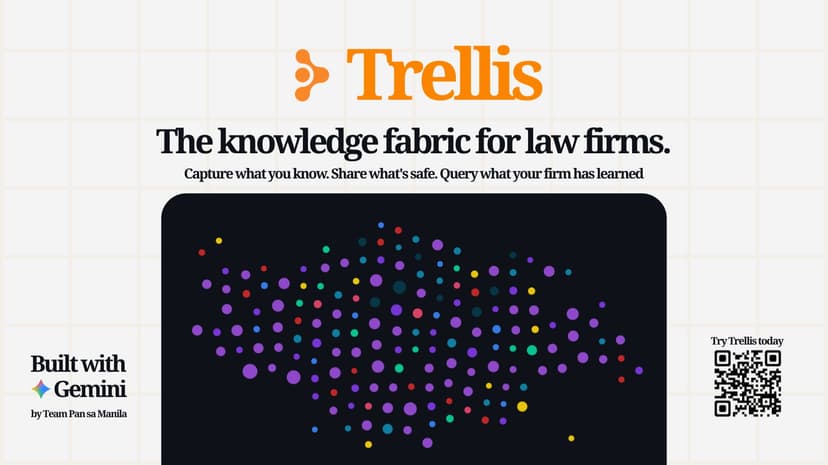
Trellis: The Knowledge Fabric for Law Firms
Every law firm sits on an unmined fortune: the experiential wisdom of senior partners. Yet, when a veteran attorney retires or departs, decades of strategic instinct permanently evaporate. This institutional knowledge loss costs mid-to-large firms $15M to $40M annually. The barrier to documentation is economic. Lawyers bill in six-minute increments; spending time writing down lessons represents an immediate loss of billable revenue. While generative AI should solve this, strict obligations toward attorney-client privilege block public LLM tools. Meanwhile, vertical legal tools like Harvey provide generic legal advice but lack a firm's specific internal wisdom. Trellis solves this with a secure, two-tier system architecture. The first layer is the Personal Second Brain. This is a private, on-device edge environment running Gemini Nano where attorneys quickly capture unstructured thoughts via voice memos, notes, or image OCR. Because data stays local, capture is entirely unredacted and factual. The second layer is the Team-Managed Knowledge Graph. This shared ledger is built through an automated, dual-pass sanitization pipeline. First, Microsoft Presidio strips explicit PII like names, dates, and entities. Second, Gemini Pro abstracts the specific case details into generalized strategic principles. The lawyer reviews a side-by-side diff before approving publication to the firm's shared memory. Using a hybrid vector-graph RAG model, team members can query this collective intelligence using natural language. To eliminate legal risk, Trellis enforces a hard deterministic guardrail: if the retrieved context score falls below a strict threshold, the system executes a strict refusal rather than risk a hallucination. Finally, Trellis exposes a Model Context Protocol (MCP) endpoint. This allows third-party tools like Harvey, CoCounsel, or Copilot to securely plug directly into the substrate, grounding generic legal AI capabilities in the firm's actual historical wisdom.
19 May 2026

