.png&w=256&q=75)
🤓 Latest Submissions
ROCm CI Doctor
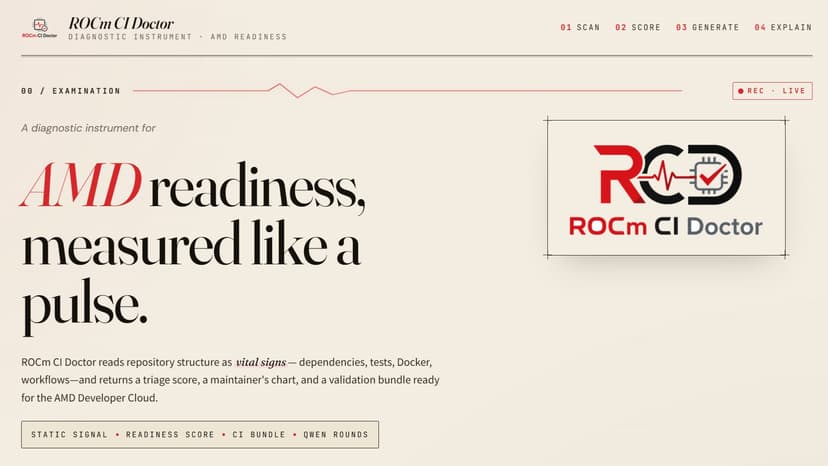
Most AI repositories are CUDA-first. Even after a one-time migration, future pull requests can quietly break AMD ROCm compatibility. ROCm CI Doctor is a developer workflow that turns this into a repeatable AMD/ROCm CI validation gate, with Qwen powering the maintainer-facing AI Doctor. The tool scans a repository, detects CUDA/NVIDIA assumptions, calculates a transparent AMD readiness score, and generates a complete validation bundle a maintainer can review in a pull request: a ROCm GitHub Actions workflow, a ROCm container Dockerfile, a torch-based smoke test, a benchmark harness, and a consolidated readiness report. Qwen is the core AI experience. Running on qwen-plus via Alibaba Cloud Model Studio (DashScope), the AI Doctor takes the deterministic analyzer's structured findings and turns them into a clear maintainer summary, then answers free-form questions like "What should I fix first before adding the generated ROCm CI workflow?" — prioritizing remediation in the maintainer's context. The deterministic analyzer remains the source of truth; Qwen is the explanation and prioritization layer that makes the report actionable. The product runs as five agents: Repo Inspector (scans source, dependencies, Dockerfiles, workflows), CI Architect (designs the ROCm validation gate), Validation Agent (generates smoke test, benchmark, and AMD Cloud evidence runner), Report Agent (writes the readiness report), and the Qwen AI Doctor. The generated bundle was executed on AMD Developer Cloud in a PyTorch ROCm 7 container. Evidence includes ROCm/HIP 7.0.51831, PyTorch 2.9 dev with rocm7.0.0, a passing smoke test in 502 ms, and a clean 2048×2048 matmul benchmark at 0.196 ms mean — committed in evidence/amd-cloud/ for independent verification. ROCm CI Doctor is intentionally not a CUDA-to-ROCm rewriter. It is a continuous AMD readiness gate, with Qwen as the maintainer-facing intelligence layer.
10 May 2026
