🤝 Top Collaborators

🤓 Latest Submissions
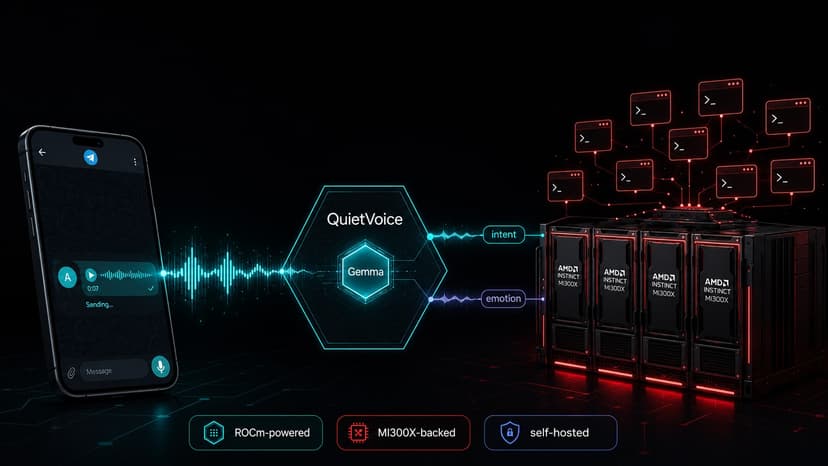
QuietVoice: voice control for AI agent swarms
QuietVoice is an asynchronous voice control plane for headless, distributed AI coding agents. You manage a swarm of remote agents by voice from your phone: the agent speaks its question to you in a cloned voice as a Telegram voice note, and you answer out loud — QuietVoice hands it back to the agent not as a raw transcript but as structured intent + emotion. The system is two planes joined by one contract. A tiny always-on control plane (CGO-free Go, no GPU) exposes two MCP tools — say and listen_voice — so any agent (Claude Code, Codex, ...) can speak and listen. A swappable inference plane, "inferenced", keeps the models hot and is byte-identical from a Mac to a consumer GPU to an AMD MI300X; only the engine binaries are rebuilt, the Go layer is the same across CUDA and ROCm. Accuracy comes from Gemma. Speech models transcribe the words in parallel, then Gemma reconciles them against the raw audio AND against the agent's own question — so it doesn't just hear the words, it knows what you are answering. A dictation box cannot do that. Self-hosted on AMD, this is our best-use-of-Gemma case. Meaningful AMD use is measured, not guessed: replication only time-slices one GPU (~2x ceiling anywhere), while the datacenter card unlocks what replication structurally cannot — continuous batching, 11.28x on MI300X. Same stack, swap binaries: portability measured at 5.3x from an M1 to the datacenter. The full listen/speak plane runs ROCm-native on AMD. Open source (MIT). Runs on ROCm.
13 Jul 2026
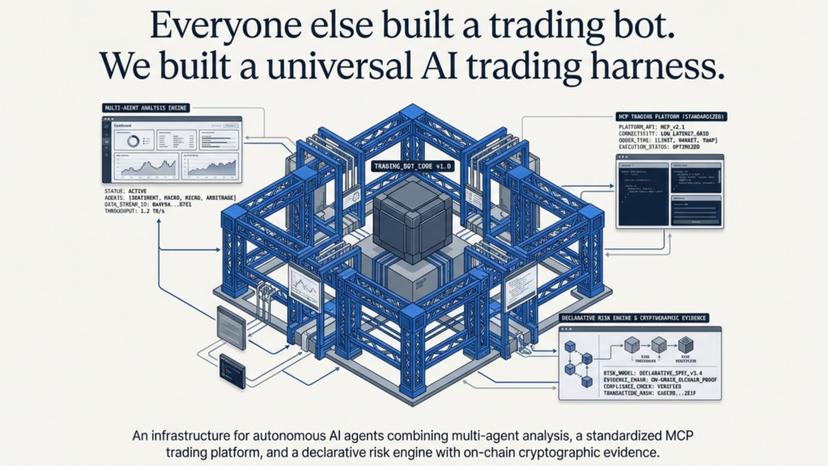
AI Trading Agents Harness by Swiftward
AI Trading Agents Harness is a platform where fundamentally different trading agent architectures share one MCP toolchain and operate under a common risk, identity, and evidence layer. Three pillars: 1. Smarter Agents - three architectures on one harness. Two jailed Claude Code agents: Alpha for momentum trading, and Gamma with five debating sub-agents and self-improving memory. A deterministic Python quant with a 3-stage mathematical brain (market filter, rotation, sizing). A Ruby arena for parallel strategy evaluation. Plus Go, Java, and Rust LLM baselines. Bi-directional Telegram: agents stream output live, operators message mid-session to guide decisions. 2. Trading Platform - 45 MCP tools across 7 servers. Multi-source market data with 7 server-side indicators, alerts, conditional orders with OCO, soft/trailing stops. Persistent per-agent Python sandbox. React 19 dashboard embedded in the trading server. 3. Super Safe - a declarative YAML risk engine with 31 live rules, 668 observed policy violations, graduated tiers, heartbeat kill switches, loss-streak circuit breaker, shadow-mode A/B testing, and eval fixtures. Claude Code agents are fully isolated in Docker with no direct network egress - all traffic forced through three gateways: Internet (domain allowlist), LLM (PG2 + BERT prompt-injection detection), MCP (per-agent tool permissions). Every decision is keccak256 hash-chained (RFC 8785 canonical JSON). ERC-8004 on Sepolia: four agents on the Identity Registry, each backed by an EIP-1271 AgentWallet. Every trade is EIP-712 signed, submitted to the Risk Router, and attested to the Validation Registry as a checkpoint, plus some Reputation Registry scores. Evidence chain is publicly queryable via GET /v1/evidence/{hash}. Kraken: execution via Kraken CLI with per-agent isolation and native stop orders. Bonus: AgentIntel - an independent audit of all 67 agents in the hackathon (7K on-chain trades, $1.5M volume) with AI verdicts and sybil/gaming detection.
12 Apr 2026


