🤓 Latest Submissions
Bellwether
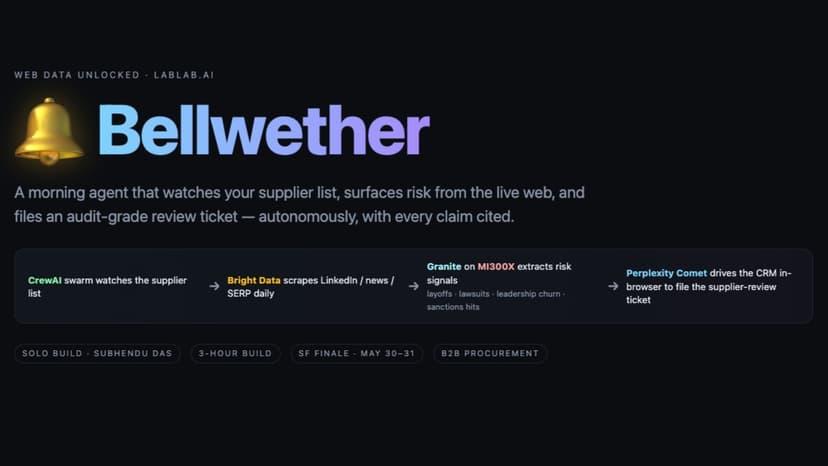
Problem. Mid-market procurement teams cover 200–2,000 active suppliers on $50M–$500M of annual spend, and review them once a year. By the time a supplier blows up — layoffs, lawsuit, CFO churn, sanctions hit — the buyer finds out from a missed delivery, not from a monitoring tool. One avoided supplier blowup pays for 35 years of Bellwether on a 200-supplier list. What it does. Every morning at 06:00 local, Bellwether wakes up and per-supplier: 1. CrewAI swarm of 4 agents (Researcher / Compliance / Analyst / Writer) fans out 2. Bright Data pulls SERP, LinkedIn, Web Unlocker evidence with provenance per record 3. OFAC SDN list fetched directly from Treasury — deterministic match, never LLM-judged 4. IBM Granite 3.1 8B Instruct on AMD MI300X (vLLM, JSON-mode) extracts structured risk signals from the evidence 5. Deterministic Python scorer (~40 lines, unit-tested) weights signals into a 0–10 score with a 7-day delta 6. Markdown memo written with every score hyperlinked to its source URL + fetch timestamp 7. Perplexity Comet drives the buyer's HubSpot tenant in-browser to file the Supplier Review ticket and assign the account owner — HubSpot REST as fallback if no Comet session token MCP-native. Bellwether ships a FastMCP server exposing `query_supplier_risk(supplier_id)` and `list_suppliers()` — a buyer's CFO can ask Claude Desktop "what's the current risk on Acme?" and get the cited memo back without leaving their tool. Auditable by design. The model extracts; deterministic Python decides. Sanctions hits pin the score at 10 via exact string match against the official OFAC list — Granite is never allowed to decide a regulatory verdict, only to describe one. Every claim in every memo carries `source_url`, `fetched_at`, `scraper_id`. Cost envelope. ~$6/month per supplier all-in (Bright Data + MI300X). One hour of an analyst is $95. Live demo (judge-touchable artifact): https://bellwether-demo.vercel.app/acme
31 May 2026

