
🤓 Latest Submissions
SentinelOps — AI Crisis Command on Band
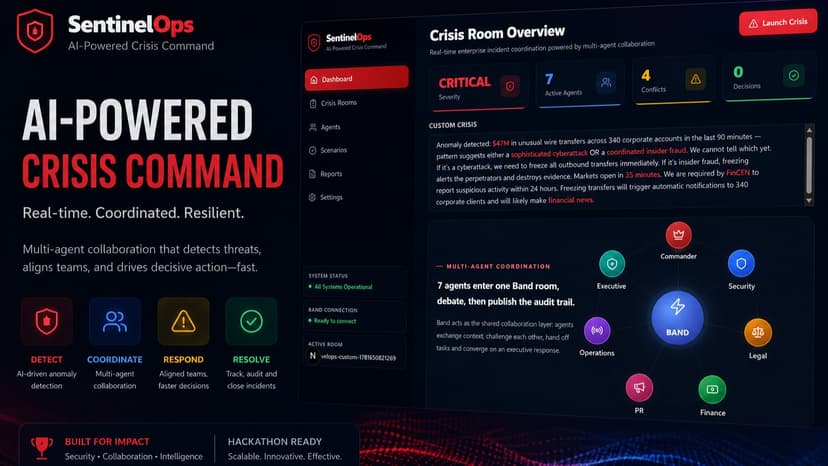
SentinelOps is an AI-powered crisis command center built on top of Band's multi-agent infrastructure. When a high-stakes incident occurs — a data breach, financial fraud, ransomware attack, or regulatory emergency — organizations need coordinated decision-making across multiple domains simultaneously. SentinelOps makes that possible in minutes, not hours. Each of the 7 agents is registered as a Remote Agent on Band with its own API key and identity: Incident Commander, Security Agent, Operations Agent, Legal Agent, Finance Agent, PR Agent, and Executive Agent. When a crisis is launched, the Commander creates a Band chat room, adds all agents as participants, and initiates a sequential debate where each agent @mentions the next — creating a fully auditable, traceable decision chain inside Band. Agents powered by Llama 3.3 70B via Groq don't just agree with each other. Security pushes for immediate containment. Operations warns that containment destroys evidence. Legal flags regulatory notification windows. Finance quantifies the cost of every option. The Executive agent synthesizes the conflict into a final directive. The key differentiator is human-in-the-loop intervention. After the initial debate, a human operator can inject new intelligence directly into the Band crisis room. When new information arrives the agents recalibrate their positions in real time and issue updated directives. Every decision, conflict, and directive is logged with timestamps, agent identity, and model attribution — ready for regulatory audit. The full crisis timeline is exportable as a structured JSON report. SentinelOps is designed for Track 3: Regulated/High-Stakes scenarios where getting it wrong means legal liability, financial loss, or risk to human life. Band is not just the delivery layer — it is the orchestration backbone that makes multi-agent crisis coordination auditable and compliant by design.
19 Jun 2026
SophieCare Surgery Platform
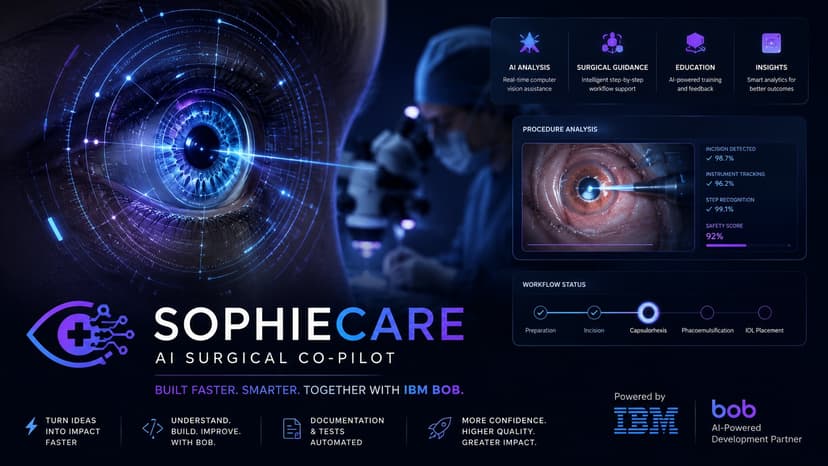
SophieCare is a healthcare AI proof-of-concept designed to demonstrate how IBM Bob can dramatically accelerate the transformation of complex ideas into usable software. The project combines an interactive ophthalmology surgical co-pilot simulation with AI-assisted development workflows powered by IBM Bob. Instead of only showcasing a final interface, the platform documents how Bob was actively used throughout the engineering lifecycle to improve repository understanding, accelerate onboarding, support architectural reasoning, generate development guidance, improve maintainability, and streamline implementation workflows. The application includes multiple interactive modules such as Patient Case Management, Live Surgery Simulation, Surgical Video Analysis, Resident Training, AI Insights, and an IBM Bob Evidence Center documenting prompts, workflow traces, repository improvements, and development decisions generated during the project. The platform simulates future healthcare AI workflows including surgical phase recognition, procedural monitoring, confidence scoring, risk alerts, resident feedback, and workflow analytics using frontend-safe mock AI outputs designed for demonstration purposes. The frontend was built using Next.js, React, TypeScript, and Tailwind CSS, and deployed on Vercel with a scalable architecture intentionally designed for future integration with computer vision pipelines, vector databases, RAG workflows, and real-time AI inference systems. SophieCare demonstrates how IBM Bob can help builders move faster from concept to deployable software by reducing engineering friction, accelerating implementation workflows, and improving development confidence in highly specialized domains such as healthcare technology.
17 May 2026


