.png&w=256&q=75)
🤓 Latest Submissions
Anirvuim: Adaptive Agent Intelligence
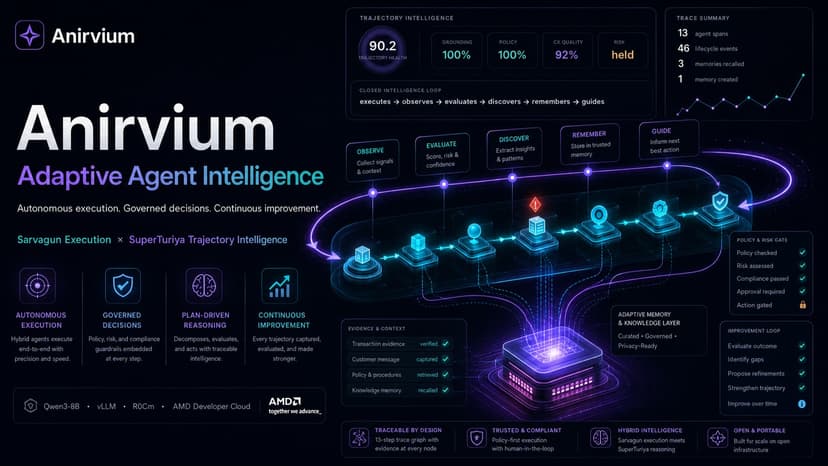
The world is moving from generative AI to agentic AI: systems that plan, use tools, change state, collaborate, and act across real workflows. Yet enterprises still evaluate them mainly by the final answer. When an agent fails, teams often cannot see which evidence shaped its plan, which tool changed state, which policy governed the action, why the failure repeated, or what should improve next. Anirvium is building the adaptive intelligence layer for this agentic world. Its core platform, SuperTuriya, captures trajectories across plans, decisions, evidence, tools, risks, approvals, confidence, and outcomes. It reconstructs execution paths, evaluates correctness and compliance, diagnoses failures, compares successful and failed runs, extracts trusted lessons, and feeds governed recommendations into future planning. Memory remains advisory, every recommendation is revalidated, and safety policy is never changed automatically. Sarvagun is Anirvium’s first reference application: a hybrid customer-support system combining autonomous execution, plan-driven reasoning, and deterministic policy control. It detects intent, emotion, recontact, SLA, and escalation risk; retrieves governed knowledge and operational records; invokes audited tools; and holds sensitive actions for human approval. SuperTuriya converts each run into reusable operational intelligence. The AMD path serves Qwen3-8B through vLLM and ROCm, supported by FastAPI, React, SQLite, Redis, Qdrant-compatible memory, and graph-based trajectory discovery. The prototype uses synthetic data and simulated connectors for reproducible evaluation. Customer support is the beachhead, not the boundary. Anirvium can expand into finance, healthcare, claims, IT operations, cybersecurity, procurement, and any domain where agents must be observable, governable, and continuously optimised. As adoption scales, Anirvium can become foundational infrastructure for the autonomous enterprise.
13 Jul 2026

