.png&w=256&q=75)
🤓 Latest Submissions
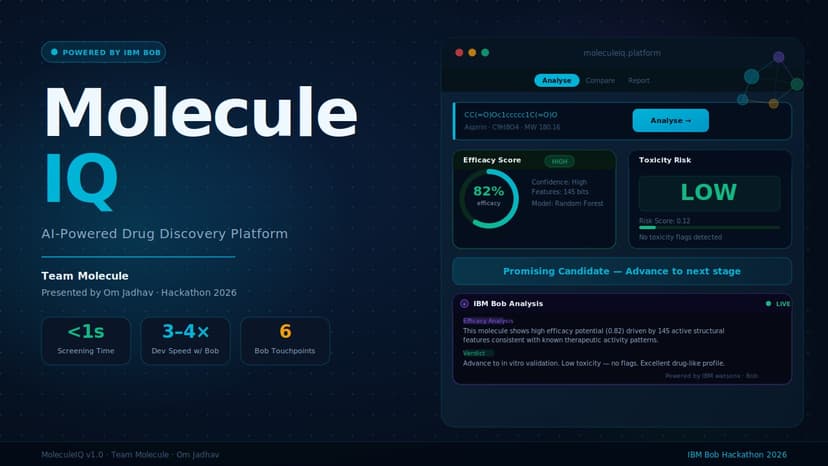
MoleculeIQ — AI-Powered Drug Discovery Platform
Drug discovery is broken. A single approved drug costs over $2 billion and takes 12 years to develop — with a 90% clinical trial failure rate. The root cause: researchers screen the wrong molecules too late, using tools that only specialists can interpret. MoleculeIQ changes that. Built entirely with IBM Bob as our AI development partner, MoleculeIQ is a full-stack platform that lets researchers paste any molecular structure (SMILES notation) and instantly receive: - Efficacy prediction (Random Forest, 0–100% probability score) - Toxicity classification (XGBoost, Low / Medium / High risk with specific flags) - Plain English explanation of every result, generated by IBM Bob in real time - Auto-generated research reports with ranked candidates and next steps IBM Bob was not just a tool we used — Bob was our development partner at every layer of the build. Bob generated our FastAPI ML pipeline from a single prompt, wrote 8 unit tests per module covering edge cases we hadn't considered, produced a 457-line API documentation guide, refactored our React components with proper error handling, and at runtime, Bob explains each molecular prediction to non-technical stakeholders in three clear paragraphs. What used to take a scientist a week of writing, Bob produces in under 8 seconds. The platform is built on a modern stack: Python FastAPI backend, RDKit for molecular fingerprint generation, scikit-learn Random Forest and XGBoost for predictions, React 18 frontend with Recharts visualization, and Docker Compose for deployment. The ML pipeline processes Morgan fingerprints (2048-bit, radius 2) and returns results in under one second. MoleculeIQ democratizes computational drug discovery — making it accessible to project managers, regulatory teams, and executives, not just data scientists. With IBM Bob, we built in one hackathon day what would normally take a team of engineers months to ship.
17 May 2026


