Basil Goodluck@noble275
5
Events attended
4
Submissions made
Nigeria
3+ years of experience
About me
My name is Basil. I specialize in building applications with Python and JavaScript, with experience across various system architectures. I work with JavaScript libraries, web automation, and algorithmic trading strategies for both crypto and forex. I'm here to grow, collaborate with skilled people, and offer value through what I’ve learned.
🤝 Top Collaborators
.png&w=640&q=75)
.png&w=640&q=75)
🤓 Latest Submissions
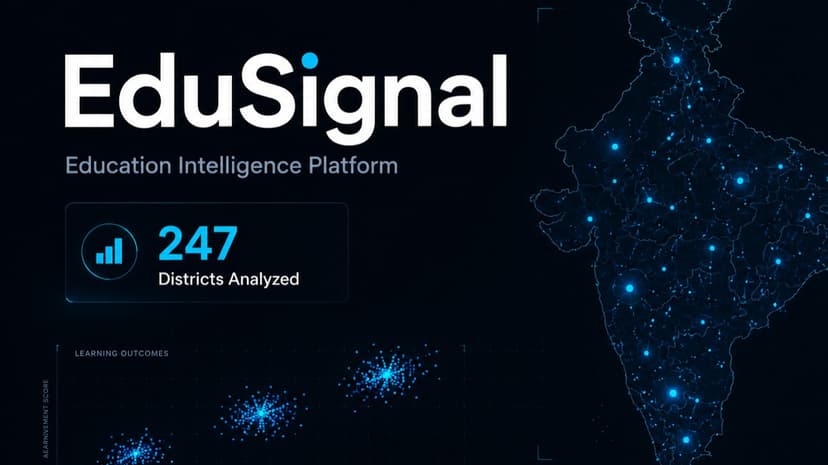
EduSignal — District Root-Cause Intelligence
EduSignal is an AI-powered education intelligence platform built to close the learning outcome gap across districts in India. The platform ingests evidence from news sources, government portals, NGO reports, teacher vacancy databases, community forums, and grievance portals using a real-time scraping pipeline powered by Bright Data. Every piece of evidence is classified by Gemini 2.5 Pro via AIMLAPI as Supporting, Contradicting, or Irrelevant to a root cause hypothesis. Districts are then clustered into six root cause categories — teacher shortage, seasonal migration, language barriers, infrastructure gaps, pedagogical failure, and noise — using HDBSCAN with UMAP dimensionality reduction and a RandomForest classifier with SHAP explainability. District education officers and policy analysts can explore an interactive map of India, drill into district-level evidence and feature breakdowns, compare peer districts, track live intervention effectiveness, monitor pipeline telemetry in real time via Server-Sent Events, and query an AI analyst backed by Gemini 2.5 Pro for contextual recommendations. The platform is fully production deployed — React 18 frontend on Vercel, FastAPI and Celery backend on Azure Container Apps, PostgreSQL with pgvector on Neon, and Redis on Upstash for task queuing and real-time event streaming. EduSignal turns fragmented, unstructured web data into a structured, explainable, and actionable intelligence layer for one of India's most critical public policy challenges.
31 May 2026

Credora - AI Credit Scoring for Informal Workers
Two billion informal workers – market vendors, drivers, farmers, and small‑scale traders – work every day, save money, and repay debts. Yet banks cannot see them because their financial evidence lives outside formal systems: bank SMS alerts, WhatsApp payment confirmations, teller deposit slips, cooperative passbooks, and handwritten receipts. No existing credit infrastructure can read any of it, so they are denied loans not because they are risky, but because they are invisible. Credora solves this by becoming a translation layer. It takes whatever evidence a worker already has – an image, a PDF, a text paste, or a spreadsheet – and extracts every financial event using a vision‑language model. The extracted transactions are cross‑checked for duplicates and fraud, then fed into a transparent scoring engine that produces an income stability score, a repayment reliability score, and a data confidence score. The final output is a single, portable credit profile that belongs to the worker and can be taken to any lender on the platform. Credora finally gives credit to the people who have been credit‑worthy all along.
10 May 2026
Runix
Runix is an execution platform built specifically for autonomous agents and software systems that need to run compute workloads without managing infrastructure. Through one unified API, you can execute code in isolated sandboxes (Python, Node, Go, and more), trigger external API calls, fetch and process data, and maintain stateful sessions across executions. Each request is sandboxed, retried automatically, and settled with per-execution pricing — you pay only for what runs, with no monthly subscriptions, no idle capacity costs, and no infrastructure to configure. Runix handles queuing, isolation, timeouts, and parallel execution out of the box. It's designed for agents, AI systems, financial services, data platforms, and any workload where traditional cloud billing models don't match actual consumption patterns.
26 Apr 2026
Quasar
Quasar is built on a simple idea: a trading system should not rely on trust or human intervention. It should read the market, understand conditions, and act with controlled risk. At its core is ARC, Adaptive Regime Control. The market is always shifting between conditions like trends, volatility, and noise. Quasar continuously identifies these regimes and adjusts its behavior. It does not use one fixed strategy. It first understands the environment, then responds accordingly. In unstable markets it becomes defensive, in clear trends it allows continuation, and in unclear conditions it reduces activity. The system is driven by deeper market data, not basic indicators. It looks at order flow, volume behavior, CVD, liquidations, open interest, funding, and trade aggression. These reflect how participants are positioned and behaving, not just price movement. This allows Quasar to read market intent, not just outcomes. Risk is built into every decision. Position sizing and exposure depend on both market conditions and system performance. When conditions are poor or performance drops, risk reduces. When alignment improves, exposure can scale. This creates a self-regulating system. Quasar is trustless because every action follows defined logic. There is no discretion or hidden decision-making. It operates consistently based on data, adapting to changing conditions while maintaining strict risk control.
12 Apr 2026


