🤓 Latest Submissions
LedgerOath
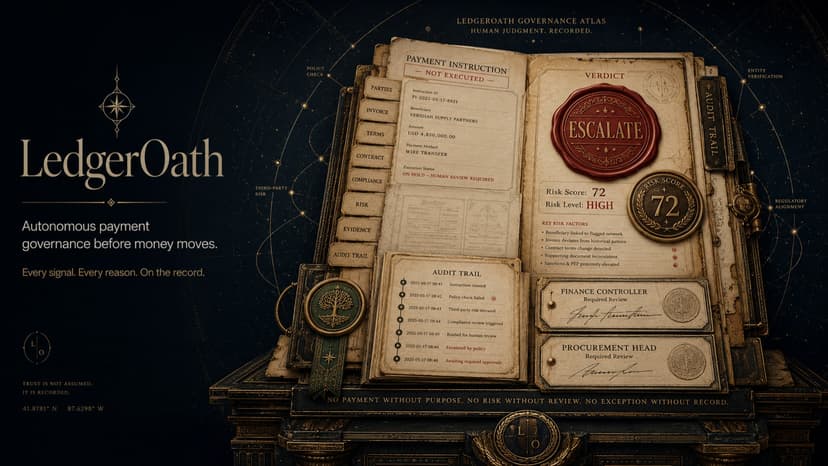
LedgerOath is an enterprise AI payment-governance platform built to review financial risk before a payment instruction is released. It helps CFO, procurement, compliance, and AI operations teams evaluate invoices, vendor master data, payment policies, budget exposure, approval thresholds, and audit signals in one structured workflow. In the demo case, LedgerOath reviews an invoice from Northline Systems Pvt. Ltd. for ₹8,42,500 and identifies multiple governance exceptions: a missing purchase order reference, a recent vendor bank-detail change, an amount above the single-approver threshold, and an early payment request. Instead of allowing the payment to proceed automatically, LedgerOath escalates the case, assigns a risk score of 72, requires Finance Controller and Procurement Head approval, and generates a complete audit dossier. The product includes a Command Center, Decision Room, multi-agent timeline, exportable audit dossier, JSON record, simulated payment instruction, auth-ready workspace, and Lovable Cloud/Supabase-ready backend architecture. LedgerOath does not execute real payments. It produces simulated payment instructions only, with a clear safety statement: no real payment has been executed.
19 May 2026
SceptreSpan
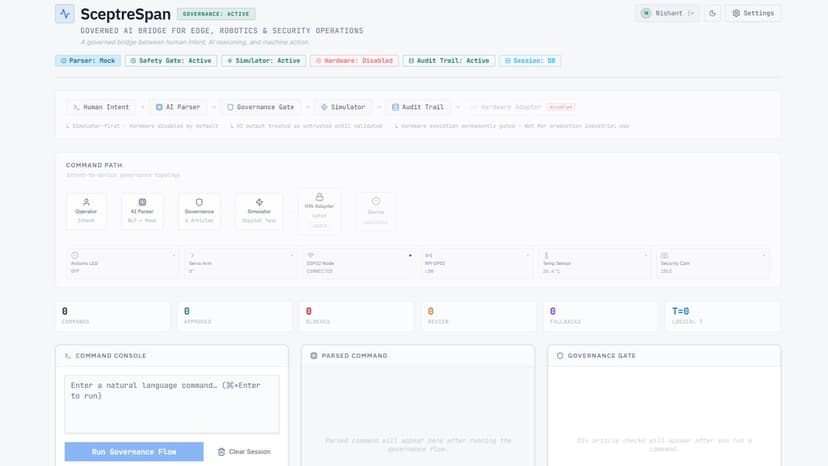
SceptreSpan is a governed AI command bridge for enterprise edge, robotics, and security operations. It converts natural-language operator intent into structured device commands, validates every action through a six-article governance gate, simulates the result inside a virtual hardware environment, and records each step in an audit trail. The project addresses a critical enterprise problem: AI agents can generate operational commands faster than humans can safely verify them. In edge, robotics, and security contexts, direct AI-to-hardware execution can create unsafe outcomes, unclear authority, and weak traceability. SceptreSpan solves this by placing a disciplined command layer between AI reasoning and machine action. The workflow is: Operator Intent → AI Parser → Governance Gate → Virtual Device Simulator → Audit Trail → Hardware Adapter Boundary. Safe commands such as LED control, servo movement, GPIO state changes, sensor reads, and camera scans are approved for simulation. Unknown commands require human review. Unsafe hardware commands, such as bypassing safety gates or activating real hardware immediately, are blocked. For this hackathon build, real hardware execution remains intentionally gated. The app demonstrates the architecture enterprises need before connecting AI agents to physical systems: governed, simulator-first, auditable, and operator-scoped.
19 May 2026


