Muhammad Yaseen@my5757980
6
Events attended
6
Submissions made
Pakistan
1 year of experience
About me
I am an experienced AI Developer with a strong hands-on background in building intelligent systems and AI-powered applications. Currently, I am actively developing AI projects that focus on solving real-world problems using machine learning, deep learning, and generative AI technologies. My work involves end-to-end development — from data collection and model training to deployment and optimization of AI solutions. I have practical experience in: Building and fine-tuning Large Language Models (LLMs) Developing computer vision and NLP-based applications Creating AI agents and automation tools Working with frameworks like LangChain, TensorFlow, PyTorch, and Hugging Face I am passionate about leveraging AI to create scalable, efficient, and impactful products. I continuously experiment with the latest advancements in AI to deliver high-quality solutions. I am very excited to bring my expertise and contribute to innovative AI initiatives.
🤓 Latest Submissions
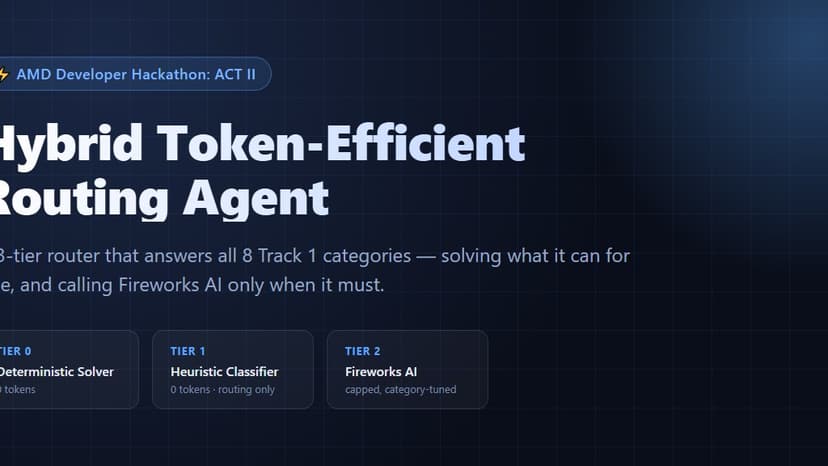
Hybrid Token-Efficient Routing Agent
Track 1 asks for a general-purpose agent that handles 8 capability categories - factual knowledge, math reasoning, sentiment classification, summarisation, named entity recognition, code debugging, logical reasoning, and code generation - while minimizing scored tokens spent through Fireworks AI. My approach is a 3-tier router. Tier 0 is a deterministic solver that handles pattern-matched arithmetic and percentage word problems in pure Python - zero tokens - and only fires when the pattern is confidently recognized, otherwise falling through safely to Tier 2 rather than risking a wrong guess. Tier 1 is a zero-token heuristic classifier (regex/keyword based) that infers which of the 8 categories a task belongs to, purely to select the right prompt template - it never answers the task itself. Tier 2 calls Fireworks AI with a concise, category-tuned prompt and a capped max_tokens, using the cheapest model available in ALLOWED_MODELS. The container reads /input/tasks.json and writes /output/results.json per the hackathon's I/O contract, is ready within seconds, and completes well under the 10-minute cap. It is built with Python 3.11 and uv, tested with 38 unit tests plus a 24-task local eval harness (16/16 correctness checks passing, all 8 categories covered), and shipped through a full Spec-Driven Development pipeline (Constitution to Specify to Plan to Tasks to Implement) via SpecKit Plus. The published GHCR image was pulled fresh and re-verified against the container I/O contract before submission.
13 Jul 2026
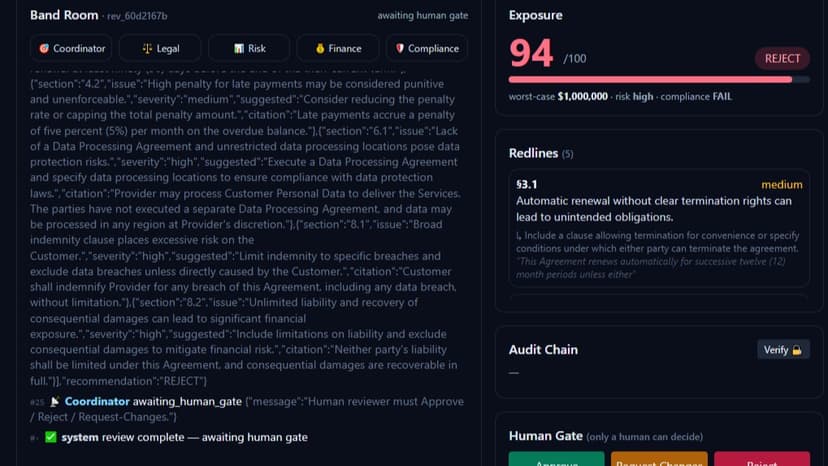
Contract Redline War Room
Contract Redline War Room is a regulated, multi-agent contract review desk where five specialized AI agents - Coordinator, Legal, Risk, Finance, and Compliance - collaborate through Band to redline a contract, quantify financial exposure, and assemble an approval packet that no single agent can sign off on alone. The Coordinator opens a Band room, discovers its peers with band_lookup_peers, and recruits the specialists with band_add_participant. Legal redlines clauses and cites the exact source text. Risk scores severity and dollar exposure. Finance computes worst-case financial impact. Compliance runs a policy check using Featherless AI's open-source inference and can VETO the recommendation, forcing a visible Coordinator re-plan loop - this is real coordination, not a fixed pipeline. Every agent-to-agent handoff, finding, state change, and discovery is a genuine Band primitive (band_send_message with @mentions, band_send_event, band_lookup_peers, band_add_participant, band_create_chatroom) driven through the real Band SDK, with each agent authenticating with its own API key. Once the agents converge on an aggregated exposure score and redline packet, a human reviewer holds the only key: Approve, Reject, or Request Changes. The decision seals a SHA-256 hash-chained audit trail; GET /api/verify/{id} recomputes the entire chain so any later edit is detectable, giving regulators a defensible record of exactly how the recommendation was reached. AI/ML API powers the primary reasoning for Coordinator, Legal, Risk, and Finance, while Featherless AI serves the Compliance agent's open-source policy-classification model - both partner technologies are exercised live and tallied at /api/health. This turns days of cross-functional contract review into minutes, with a tamper-evident sign-off record built for Track 3: Regulated and High-Stakes Workflows.
19 Jun 2026
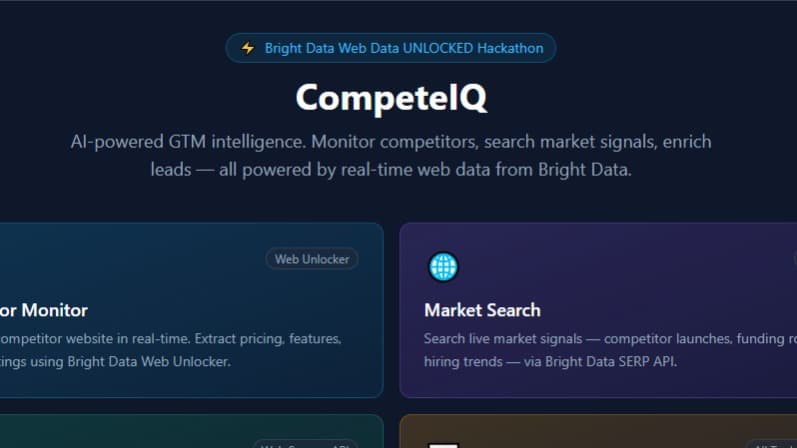
CompeteIQ — GTM Intelligence AI Agent
CompeteIQ is a full-stack AI-powered GTM Intelligence Agent built with Next.js 15 and powered by Bright Data's web data infrastructure. The platform delivers four core intelligence capabilities for go-to-market teams: 1. Competitor Monitor — Paste any competitor URL and CompeteIQ uses Bright Data's Web Unlocker API to fetch live web content, extract structured data with cheerio, and generate an AI-powered summary using Groq's llama-3.3-70b model. Sales teams instantly understand pricing changes, product updates, and positioning shifts. 2. Market Search — Run natural language market intelligence queries powered by Bright Data's SERP API. Results are surfaced with AI-generated insights, giving GTM teams a real-time pulse on the competitive landscape without manual research. 3. Lead Enrichment — Enter any company name to trigger Bright Data's Web Scraper API, which extracts firmographic data including industry classification, tech stack signals, and company profile information in seconds. 4. Intelligence Report — The flagship feature: a 4-agent SSE-streaming pipeline that generates a comprehensive competitive intelligence report with sections covering Market Position, Technology Stack, Growth Signals, Competitive Landscape, and Strategic Recommendations. The report streams live to the browser using ReadableStream, giving users a real-time agentic experience. Tech Stack: Next.js 15 App Router (full-stack, no separate backend needed), TypeScript, Tailwind CSS, Groq SDK with llama-3.3-70b-versatile, Bright Data Web Unlocker + SERP API + Web Scraper API, cheerio for HTML parsing, deployed on Vercel. CompeteIQ turns hours of manual competitive research into a 30-second automated intelligence workflow — built entirely on Bright Data's live web access infrastructure.
31 May 2026
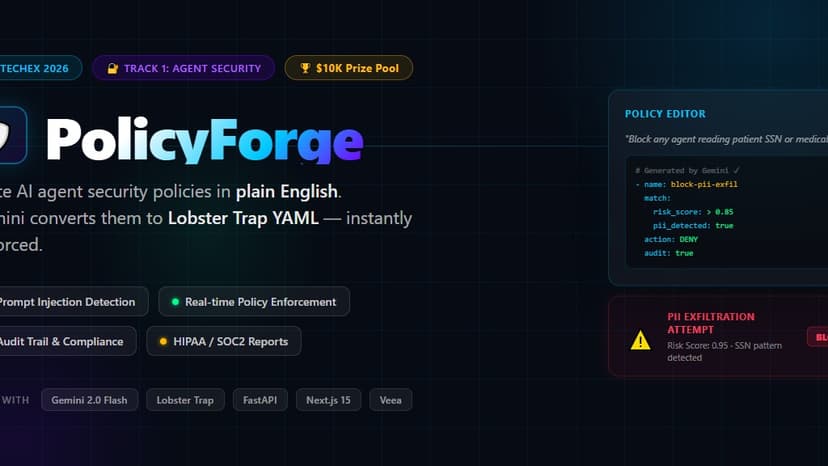
PolicyForge — AI Agent Security Policy Platform
PolicyForge is an enterprise AI agent security platform that solves a critical gap: security teams cannot write or manage AI agent policies because existing tools require deep YAML expertise. With PolicyForge, any CISO or compliance officer can type a security intent in plain English and have it enforced in seconds. How it works: The user types a natural language policy such as "Block any agent that reads patient SSN or medical records." Gemini 2.0 Flash instantly converts this into a Lobster Trap YAML enforcement rule. The rule is activated and enforced immediately by the Veea Lobster Trap deep prompt inspection proxy — a MIT-licensed tool that sits between AI agents and LLM backends. Key features include a real-time security dashboard showing blocked threats, active policies, and risk scores. An attack simulator lets teams fire 10 real adversarial attacks — prompt injection, PII exfiltration, credential theft, SQL injection, jailbreak attempts — and watch them get blocked live. One-click compliance reports generate HIPAA, SOC2, and finance audit documents directly from the audit trail. PolicyForge directly addresses every Track 1 focus area: guardrails and safety layers, monitoring and observability, access control, audit trails with explainability for regulated industries, and red-teaming frameworks. The tech stack uses Gemini 2.0 Flash for policy generation, Veea Lobster Trap for DPI enforcement, FastAPI for the backend, and Next.js 15 for the frontend — deployed on Railway and Vercel.
19 May 2026
.png&w=828&q=75)
DocuMind AI — Multi-Modal Document Intelligence
DocuMind AI is a multi-modal, multi-agent document intelligence platform built on AMD MI300X GPU infrastructure via Fireworks AI's OpenAI-compatible inference API. The Problem: Professionals spend hours manually extracting insights from complex documents containing both text and visual content (charts, diagrams, figures). Existing tools handle text OR images, not both together. The Solution: DocuMind AI runs a sequential 4-agent CrewAI pipeline on AMD Instinct MI300X GPUs: 1. Vision Agent — uses Kimi K2.5 to analyze every image, chart, and diagram embedded in the document 2. Reader Agent — uses DeepSeek V3.1 to extract text, identify entities, classify document type, and extract key facts 3. Analyst Agent — synthesizes visual AND textual findings into cross-modal insights 4. Reporter Agent — produces a structured intelligence report: Executive Summary, Key Entities, Categorized Insights, and Actionable Recommendations AMD Technology Used: AMD Instinct MI300X GPUs via Fireworks AI with OpenAI-compatible API — zero-friction integration with CrewAI and Python AI ecosystem. Kimi K2.5 vision-language model + DeepSeek V3.1 open-source frontier text model, both running on AMD hardware. Why This Matters: Covers Track 1 (AI Agents) AND Track 3 (Vision/Multimodal). Real business value for researchers, analysts, and professionals. Live demo on Hugging Face Spaces with zero setup required for judges. MIT open-source with full documentation.
10 May 2026

AgentFlow: AI Agent Economy on Arc
AgentFlow is a real-time economic execution layer for AI agents built on Arc L1 blockchain and Circle infrastructure. Five specialized AI agents — DataAnalyst, ContentWriter, CodeReviewer, Translator, and Orchestrator — autonomously bid, subcontract, and settle USDC micropayments on-chain with no human intervention. Each agent has its own Circle Developer Controlled Wallet pre-funded with 20 USDC. When a task is submitted, the Orchestrator agent routes it to the appropriate specialist, deducts micro-payments ($0.002–$0.008 USDC per task) from agent wallets, and settles on the Arc blockchain in real-time. The live dashboard displays every transaction hash, agent balance, and payment status as it happens. We demonstrated 55 confirmed on-chain transactions totaling $0.31 USDC settled in approximately 30 seconds. Arc's near-zero gas fees make sub-cent machine-to-machine commerce economically viable for the first time — on Ethereum, $1 gas fees would destroy the entire value of these micropayments. Technical stack: FastAPI backend, Next.js 15 frontend, Circle DCW API, Arc EVM L1 testnet. The x402 payment protocol was also wired for HTTP-native payment headers, enabling future pay-per-API-call monetization at internet scale.
26 Apr 2026


