.png&w=256&q=75)
🤓 Latest Submissions
PHANTOM
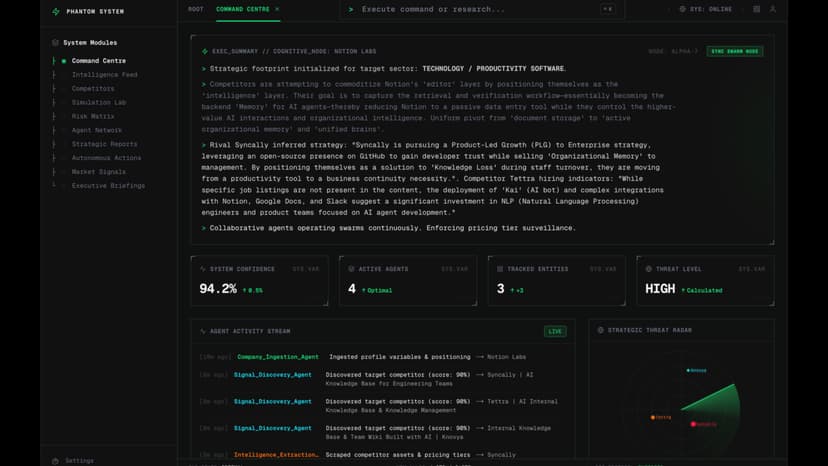
Instead of acting like a chatbot or analytics dashboard, PHANTOM operates as a living AI intelligence network that continuously monitors competitors, market signals, operational risks, and emerging business opportunities using collaborative AI agents powered by Gemini. Companies today struggle to track rapidly changing competitive landscapes. Critical signals are scattered across competitor websites, hiring trends, product launches, pricing changes, investor activity, market sentiment, and industry reports. Human teams cannot continuously analyse and reason across this volume of information in real time. PHANTOM solves this by autonomously discovering, analysing, and reasoning about strategic business threats and opportunities. Users onboard by providing company information such as their website, products, industry, target market, and strategic goals. The app then builds a strategic intelligence model of the organisation and uses autonomous agents to identify direct competitors, emerging startups, adjacent market threats, and substitute products. Using Exa for semantic intelligence discovery and Firecrawl for deep competitor crawling, PHANTOM continuously analyses: competitor positioning, pricing changes, hiring activity, product evolution, adoption signals, infrastructure growth, market expansion patterns sentiment shifts. Specialised AI agents collaborate to generate strategic hypotheses, simulate business impact, predict competitor moves, and recommend actions. PHANTOM doesn't just surface information — it reasons about it. For example, the system can infer that a competitor is preparing an enterprise AI product launch based on hiring trends, infra expansion, messaging changes, and product signals before the market fully recognises it. The platform also provides executive-grade strategic briefings, predictive simulations, risk analysis, and autonomous response recommendations, transforming fragmented business intelligence into actionable strategic foresight.
19 May 2026
Titan
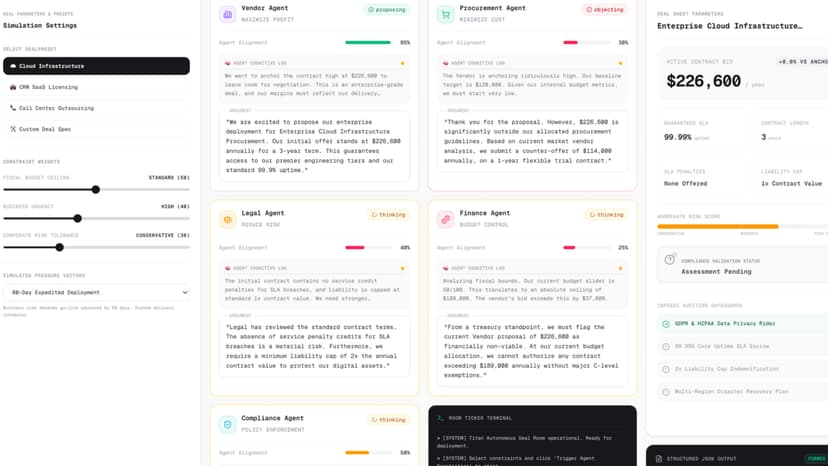
TITAN is an autonomous enterprise negotiation platform powered by multi-agent AI systems using Gemini. It simulates how real enterprise stakeholders negotiate complex contracts, procurement agreements, and operational deals in real time. In large organisations, enterprise negotiations are slow, fragmented, and heavily manual. Legal, procurement, finance, compliance, and vendors often operate across disconnected workflows, resulting in long approval cycles, operational friction, delayed execution, and costly inefficiencies. TITAN reimagines this process as an intelligent autonomous workflow. The platform creates specialised AI negotiation agents representing key enterprise stakeholders: * Vendor Agent * Procurement Agent * Legal Agent * Finance Agent * Compliance Agent Each agent operates with unique goals, constraints, and reasoning patterns. During a negotiation session, agents negotiate pricing, SLAs, delivery timelines, penalties, compliance requirements, and risk clauses over multiple rounds. Gemini powers the reasoning engine behind each agent, enabling structured trade-offs, constraint-aware decision-making, and dynamic negotiation behaviour. TITAN provides a live operational “Deal Room” interface where users can watch negotiations evolve in real time. As negotiations progress, the platform updates deal state dynamically, highlights conflicts, surfaces risks, and explains why concessions or rejections occur. At the end of the negotiation, TITAN produces a final structured agreement along with a reasoning trace and trade-off analysis. The project demonstrates practical enterprise AI workflows beyond simple chat interfaces. Instead of a single assistant responding to prompts, TITAN showcases coordinated multi-agent reasoning, operational decision-making, and autonomous workflow simulation — all highly relevant to real-world enterprise operations. Built with Next.js, TypeScript, and Gemini 3 Flash
19 May 2026
Pulse
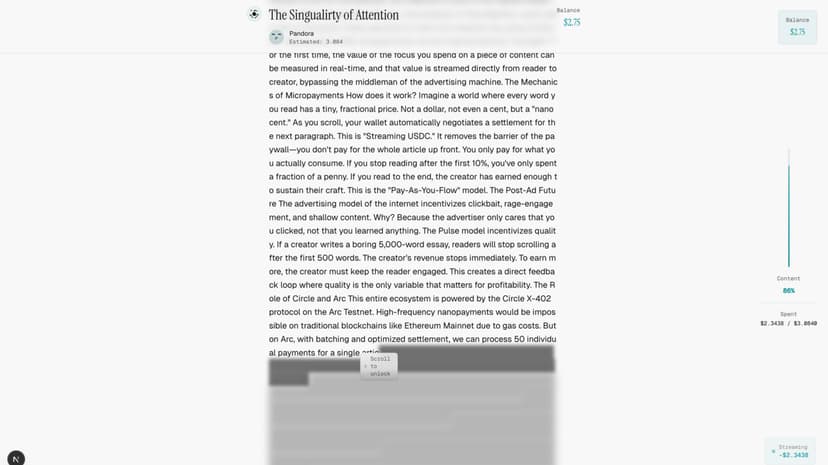
Pulse is a real-time pay-as-you-read platform that turns content into a streaming economic asset. Instead of subscriptions or fixed paywalls, users unlock articles progressively as they read, paying tiny amounts of USDC per segment of text. As a user scrolls, new content is revealed in small increments, and each reveal triggers a sub-cent nanopayment. If the user stops reading, payments stop instantly, creating a direct link between attention and value. This model introduces a fundamentally new way to price information. Rather than paying upfront for content they may not fully consume, users only pay for what they actually read, down to the character level. At the same time, creators can monetise every unit of attention, capturing value continuously instead of relying on ads or subscriptions. Pulse is powered by Circle’s Nanopayments infrastructure with settlement on Arc, enabling high-frequency, low-cost transactions that would be impossible on traditional blockchains. A single reading session can generates multiple transactions, each costing less than a fraction of a cent, while remaining economically viable due to predictable, minimal fees. The platform abstracts all blockchain complexity through a simple “reading balance,” allowing users to fund their account and seamlessly stream payments in the background without interruptions. Pulse demonstrates a new economic primitive for the internet: real-time, usage-based pricing for information. By aligning cost directly with consumption, it creates a fairer, more efficient model for both users and creators, and showcases how programmable money can unlock entirely new digital experiences.
26 Apr 2026


