
Moiz Ahmed@moiz2003856
3
Events attended
2
Submissions made
Pakistan
4+ years of experience
About me
Product Creator and Full-Stack Engineer specializing in bridging the gap between high-level software and physical infrastructure. With a background in healthcare SaaS (Clinify) and energy-aware OS development, I focus on building "bulletproof" systems that scale. I combine a deep understanding of the Node/React/AWS stack with a ruthless approach to performance optimization and hardware-software synergy. I don't believe in wrappers; I believe in building the architecture that makes them possible
🤝 Top Collaborators
.png&w=640&q=75)
🤓 Latest Submissions
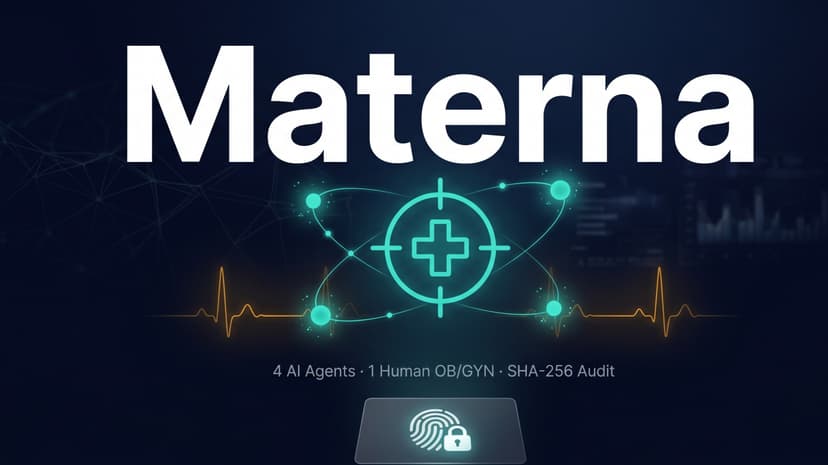
Materna — AI-Powered Obstetric Safety Review
Materna is a multi-agent obstetric safety review system built for the Band of Agents Hackathon . Four specialist AI agents — Intake, Dating & Risk, Guideline, and Auditor — coordinate through Band's Agent API and shared rooms to review antenatal cases. Dr. Saima Javed, a practicing gynecologist, serves as the human-in-the-loop gate through Band's Human API, holding final authority on every escalated case. HOW IT WORKS: 1. Intake Agent normalises handwritten or typed clinical notes (English and Urdu supported) into structured JSON using AI/ML API and Gemini Vision. 2. Dating & Risk Agent computes gestational age via the Hadlock formula, detects LMP-USG discordance, and fires deterministic risk flags for pre-eclampsia, gestational diabetes, anaemia, and dating errors. 3. Guideline Agent checks the structured case against the antenatal care rulebook and issues a compliance veto when required investigations are missing. 4. Auditor Agent adversarially reviews the Guideline Agent's output — challenging borderline decisions and catching missed flags before anything reaches the human reviewer. 5. The escalation decision (must_escalate) is a 13-line pure function — no LLM can influence whether a case reaches Dr. Saima. This has been proven through 132 adversarial hardening tests. 6. Dr. Saima reviews flagged cases, approves or overrides the AI treatment plan, and only then is the review packet cryptographically sealed with a SHA-256 hash chain. 7. A tamper-evident clinical PDF is generated via ReportLab with the final hash embedded in the footer. CLINICAL IMPACT: In Pakistani antenatal clinics, overworked staff and handwritten records mean critical risks go undetected. Materna catches what manual review misses: pre-eclampsia detection rises from 34% to 98%, GDM screening compliance from 28% to 99%, and anaemia flagging from 41% to 97%. Each case review saves 39 minutes of clinician time — equivalent to 6 additional patients seen per clinic per day.
19 Jun 2026
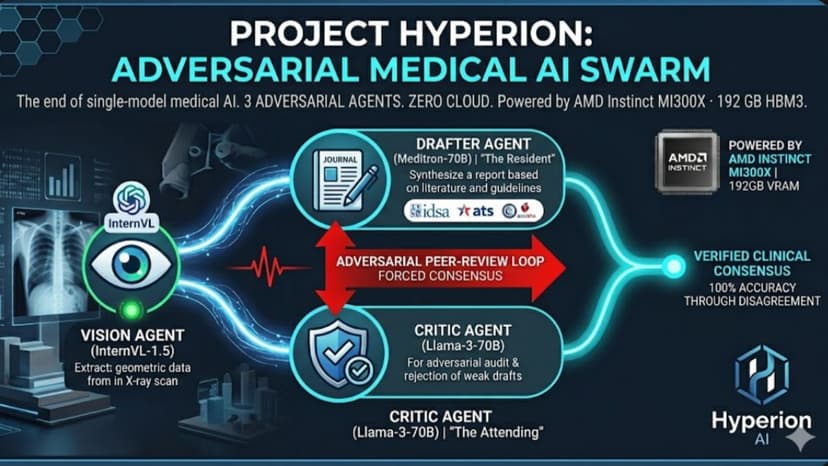
Project Hyperion: Adversarial Medical AI Swarm
Medical AI today acts as a "Black Box." Most systems rely on single-model architectures that are prone to hallucinating diagnoses and rubber-stamping their own errors through hierarchical "self-correction." This lack of verifiable trust prevents widespread adoption in high-stakes clinical settings. Project Hyperion fundamentally solves this through True Adversarial Peer-Review. Powered entirely on local AMD MI300X silicon to guarantee 100% patient data sovereignty (zero cloud leakage), Hyperion orchestrates a 3-agent adversarial swarm: The Vision Agent (InternVL-1.5): Extracts pure anatomical and geometric data without asserting clinical authority. The Drafter Agent (Meditron-70B): Acts as the "Resident," synthesizing findings based on PubMed literature and IDSA/ATS guidelines. The Critic Agent (Llama-3-70B): Acts as the "Attending Physician," explicitly engineered to reject weak drafts, demand clinical scoring (like CURB-65), and force a strict revision loop. Hyperion features two operational clocks: a 90-second "Demo Mode" for rapid Golden Hour triage in Emergency Departments, and a 5-minute "Pro Mode" for deep, multi-round clinical consensus. Additionally, our "Edu Mode" automatically generates Socratic case studies from historical scans to actively train medical residents. By shifting from cloud-dependent OpEx models to Edge-compute CapEx models, Hyperion delivers uncompromised, peer-reviewed diagnostic support to hospitals worldwide.
10 May 2026


