
Muhammad Zaid Tahir@mlengineer4470181
1
Events attended
1
Submissions made
Pakistan
1 year of experience
About me
Emerging AI/ML Engineer with hands-on expertise in Generative AI, LLM orchestration, LangChain, LangGraph, RAG pipelines, and Agentic AI systems. Skilled in building end-to-end AI-powered full-stack applications using Python, FastAPI, Flask, and React, with a strong foundation in machine learning, NLP, deep learning, and computer vision. Proven problem solver with top-tier competition results and practical hackathon experience building production-ready AI tools. Professionally delivers complete frontend and backend development by leveraging AI coding assistants (Cursor, GitHub Copilot, Claude, Antigravity) to accelerate architecture, implementation, debugging, and deployment—an AI-augmented engineering workflow that increases delivery speed without compromising code quality.
🤝 Top Collaborators

🤓 Latest Submissions
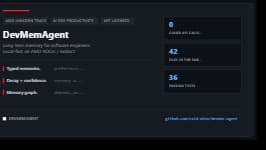
DevMemAgent: Dev Memory on AMD ROCm
DevMemAgent is a developer-productivity memory agent that gives coding assistants persistent, structured long-term memory across conversations. Today's LLM tools are amnesiac — every new chat starts from scratch, so preferences get re-stated, recurring build errors get re-debugged, and sprint context evaporates between threads. DevMemAgent fixes this by listening to developer sessions and persisting what matters: typed memories tagged as preference, fact, event, goal, or relationship. Built as a fork of the LangChain memory-agent template (MIT, attributed), it adds three differentiators over the upstream ReAct loop. First, a typed memory schema with five categories so retrieval can filter by what the user is actually asking about. Second, decay and confidence scoring — each memory carries a confidence score and optional TTL, with a recency-weighted effective score used to re-rank retrieved memories so stale or low-confidence facts naturally fade. Third, a memory graph with typed edges (depends_on, supersedes, contradicts, related_to, refines) enabling graph-aware recall for questions like "what changed since X?" The stack runs local-first on AMD ROCm / Instinct GPUs via Ollama — default models are llama3.1:8b for chat and bge-small-en for embeddings, both executing on-device. The Docker image uses rocm/pytorch:6.3.2-ubuntu-22.04-py311 with GPU passthrough through /dev/kfd and /dev/dri. Cloud providers (OpenAI, Anthropic) are optional fallbacks for A/B quality comparison but are never required. A CPU-only docker-compose override enables demos on any host. The submission includes 42 source files, 36 passing unit and integration tests, a 5-case recall/precision eval harness, a reproducible 3-minute demo script, a 12-slide pitch deck, and a Docker Compose stack that launches the agent with one command. The codebase includes a professional README, architecture documentation, and a NOTICE file crediting LangChain upstream. License: MIT (preserved from upstream).
13 Jul 2026
