.png&w=256&q=75)
🤓 Latest Submissions
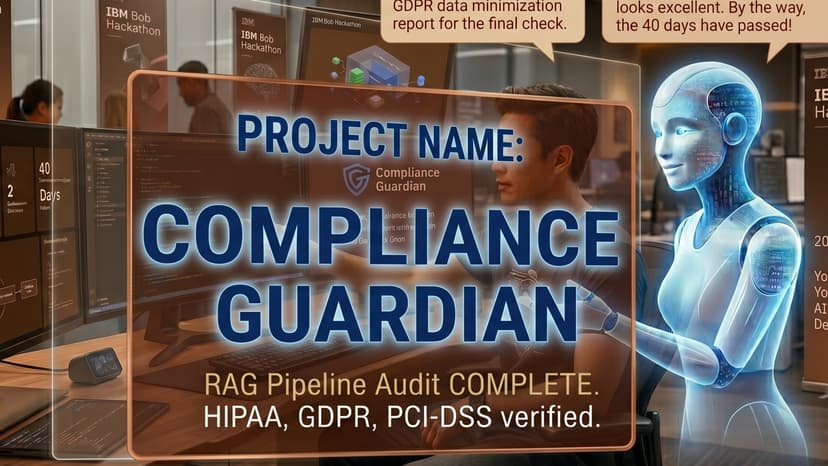
Bob’s Compliance Guardian
Building a production-ready regulatory compliance scanner usually requires an entire engineering team and a massive budget. Compliance Guardian was built completely solo in a single weekend to prove a new reality: with IBM Bob as a senior development partner, a single developer can build enterprise-grade software at absolute lightning speed. The application automatically clones any GitHub repository and runs a three-phase pipeline—combining rapid regex scanning with a local RAG vector store—to audit source code against the precise legal text of GDPR, HIPAA, PCI-DSS, and ISO 27001. Every single layer of this complex architecture was engineered, optimized, and debugged through 40 intensive IBM Bob sessions: Architectural Blueprinting: Instead of writing isolated code snippets, IBM Bob operated with full repository context. It allowed the seamless wiring of a local SQLite vector database and asynchronous background workers into a Flask orchestrator without breaking existing endpoints or causing architectural drift. Rapid Component Generation: For the initial static analysis phase, Bob vaporized days of tedious work by instantly generating a massive, highly structured regex pattern library, complete with severity mappings to flag hardcoded secrets and unauthenticated routes. Prompt Engineering inside the IDE: Getting language models to consistently output perfectly structured compliance fields is notoriously difficult. Bob acted as a sounding board inside the workspace, iterating on complex system prompts until the parser achieved absolute reliability. Compliance Guardian is a testament to developer velocity under the new paradigm of AI-partnered engineering. By leveraging IBM Bob’s ability to read entire repository structures, reason through multi-step logic, and maintain context across complex workflows, months of expensive enterprise software development were compressed into 48 hours.
17 May 2026
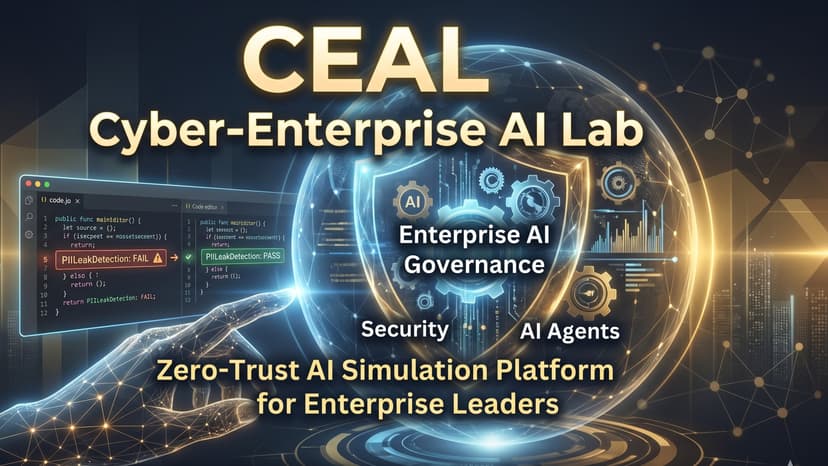
CEAL Lead — Hackathon Submission Writeup
The Problem Software developers are being told to "lead AI transformation" — but nobody is training them for it. They know how to ship code. They don't know how to defend a £200,000 AI budget to a CFO, run a mock EU AI Act regulator audit, or design a multi-agent pipeline that a risk committee will actually approve. Generic AI courses give them theory. Certifications give them badges. Neither puts them under real pressure. 82% of leaders use GenAI weekly but cannot prove ROI to their board. 0% of traditional developer training covers EU AI Act or Agentic Governance. What CEAL Lead Does CEAL Lead is a simulation-based enterprise AI certification platform. It puts developers inside 30 real workplace scenarios across 6 modules and forces them to survive interrogation by an AI consultant powered by Groq (llama-3.3-70b-versatile). This is not a quiz. This is not a video course. Every level: Opens with a specific high-stakes scenario — a board meeting, a regulatory audit, a production incident, a VC pitch, a post-mortem Deploys a hostile AI consultant that challenges every vague answer, scores every response, demands specifics and numbers Presents real code snippets with deliberate flaws and asks users to debug, rewrite, and explain the business impact Requires minimum 20 exchanges before completion is available — there is no rushing through Gates completion at 70/100 — the AI will not let users finish until they have genuinely justified their position
19 May 2026
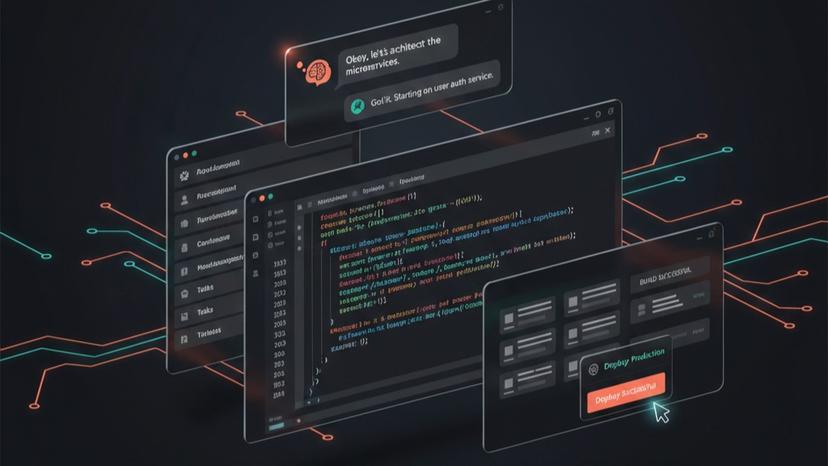
WritenDraw Flight Simulator for Software Developer
WritenDraw is an agentic AI simulation platform that puts junior developers through realistic production incidents to bridge the gap between learning to code and working in a real team. The core innovation is the agentic workflow: Google Gemini 2.0 Flash orchestrates the entire simulation through three autonomous agents: AGENTIC EVALUATION: Every step requires free-text responses (no multiple choice). Gemini evaluates each response against per-step rubrics, scoring reasoning 0-15. The AI adapts feedback based on accumulated performance. AGENTIC MENTORING: The AI mentor maintains persistent context, tracking understanding level, chat count, and time pressure. Early messages: patient, asks "what do you think?" By message 7+: "just write it up." The agent autonomously decides how much help to give. AGENTIC AUDIT: The system logs every response, chat message, code submission, and score — creating a complete picture of how a developer thinks through a crisis. The AI continuously assesses and adapts. The simulation drops you into a P1 incident at ShopRight (fictional UK supermarket). You join a standup, read a Jira ticket, investigate messy code with no hints, chat with the AI mentor, write a fix, respond to code review, create a deployment plan, and contribute to a retro. Paste is disabled — Key insight: explanation scores higher than code (10 vs 5 points). Wrong code with a great explanation beats perfect code with no explanation — because in real teams, communication matters as much as code. Built on the author's published research — "TrueSkills: AI-Resistant Assessment Through Personalized Understanding Validation" (SSRN, 2025, DOI: 10.2139/ssrn.5674130) — which demonstrated that AI-resistant assessment requires evaluating understanding rather than recall. WritenDraw takes this further: testing how developers think under realistic production pressure. Built with Python/Flask, Google Gemini 2.0 Flash, CodeMirror, Pyodide, and Docker.
15 Feb 2026


