.png&w=256&q=75)
🤝 Top Collaborators
.png&w=640&q=75)
.png&w=640&q=75)
🤓 Latest Submissions
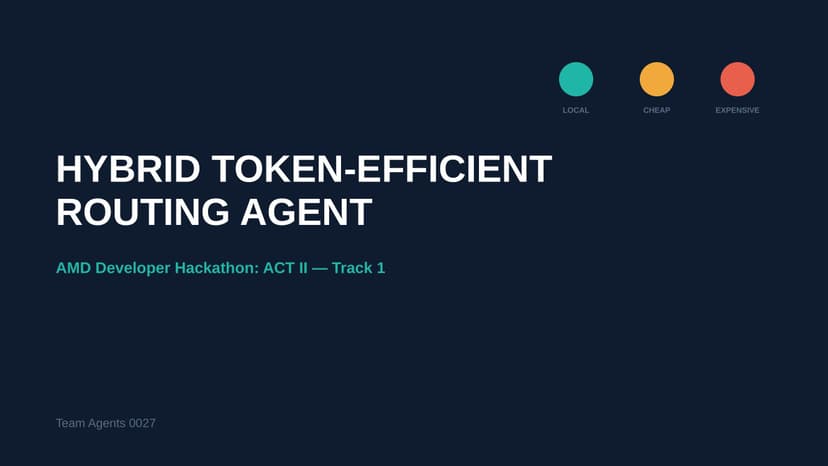
Hybrid Routing Agent 0027
Our submission for Track 1 is a three-tier hybrid routing agent that minimizes Fireworks token usage while staying above the 80% accuracy gate. How it works: Each incoming prompt is analyzed by a lightweight, rule-based classifier that routes it to one of three tiers: Local (zero tokens): Short factual questions and sentiment analysis are answered by a quantized Qwen2.5-0.5B-Instruct model bundled directly inside our Docker container — no API call, no cost. Cheap tier (Fireworks kimi-k2p6): General knowledge, math reasoning, summarization, NER, and logic puzzles. Expensive tier (Fireworks deepseek-v4-pro): Reserved only for code debugging and code generation, the categories where correctness risk is highest. Why this split? Rather than assuming which tasks need a stronger model, we empirically tested both Fireworks tiers across all 8 scored categories using our own labeled test set with known correct answers. We found the cheap model matched the expensive model's accuracy on every non-code category — so escalating those tasks would waste tokens without improving correctness. Only code tasks showed a genuine reliability gap, so that's the only place we pay for the stronger model. Reliability: Each task runs in its own error boundary — if one task fails (timeout, unexpected response, etc.), it degrades to a single wrong answer rather than crashing the entire submission. Results: On our 16-task local test set spanning all 8 categories, our router achieved 87.5%+ accuracy while sending only 4/16 tasks to the expensive tier and answering 3/16 completely free via the local model — roughly a 43% reduction in expensive-tier calls compared to our earlier, more conservative routing rules, achieved by testing assumptions empirically instead of guessing. Stack: Python, Docker, Fireworks AI, llama-cpp-python (local inference).
13 Jul 2026
