

Marco Giuliani@marcogiuliani
2
Events attended
2
Submissions made
Italy
20+ years of experience
About me
Graduated in Physics. Senior Software Engineer with over 25 years of experience in developing enterprise applications for network management systems in the telecommunications sector. Specialized in React/JavaScript (frontend) and Java/Spring (backend), with solid experience in real-time architectures, interactive network maps, and complex data integration. In recent years, I have developed expertise in AI/ML—embeddings, vector databases, OpenAI APIs—both in professional settings and personal projects, with the goal of bringing intelligent features to modern web applications.
🔥 Own Projects


🤓 Latest Submissions
.png&w=828&q=75)
Find Nearby Places
AI Hiking — Discover Your Mountain, Inside and Out AI Hiking is an AI-powered platform that helps users find the perfect hiking trail in Italian mountain regions through natural language search, combining semantic vector search with real-time weather filtering. The Problem Mountain destinations are rich with experiences — trails, rifugi, local guides, cultural sites, events — but this information is scattered across dozens of regional tourism portals, municipality websites, and outdoor platforms, with no unified access point. The Solution Using Bright Data's Web Scraper API and Dataset platform, AI Hiking automatically collects and normalizes POI data (points of interest) from heterogeneous Italian tourism sources: regional portals, OpenStreetMap-based directories, local event boards, and mountain hut listings. Bright Data handles the complexity of geo-distributed scraping, bypassing regional blocks and aggregating structured data at scale. This enriched dataset feeds directly into the "Explore the Area" feature: given a mountain location, users instantly see everything nearby — guided tours, rifugi with contacts and hours, nature reserves, cultural landmarks, and local activities — all rendered on an interactive map. Tech Stack React PWA · Node.js/Express · MongoDB · OpenAI Embeddings · Vectra · Bright Data · Open-Meteo · Leaflet
31 May 2026

Psychotherapy Orientation Agent
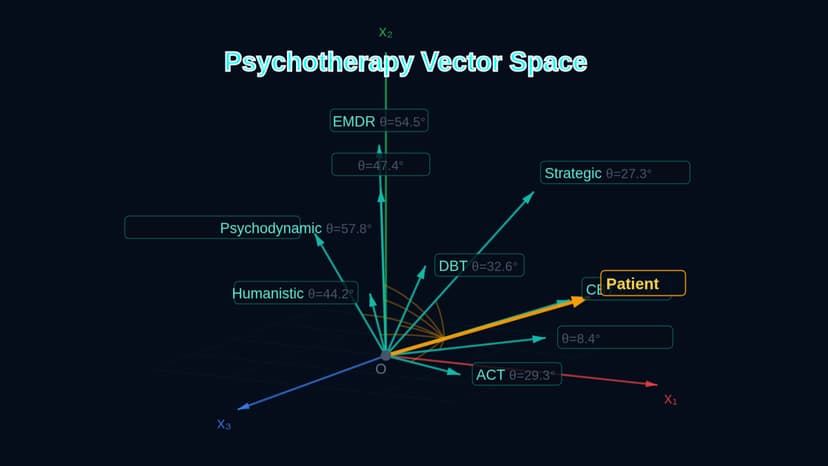
Psychotherapy Orientation Agent is an experimental AI-powered decision-support prototype that explores how conversational AI and vector-based modeling can help users navigate different psychotherapy approaches. The system conducts a multi-turn conversational interaction using Google Gemini, combining free-text responses with structured inputs to build a multidimensional behavioral profile based on communication patterns, preferences, symptom descriptions, and self-reported context. A computational matching pipeline then transforms this profile into a numerical representation and compares it against predefined therapy archetypes using vector similarity scoring (cosine similarity). Rather than making diagnoses or clinical recommendations, the system explores how explainable mathematical matching models might support psychotherapy orientation and comparative decision support. The architecture combines LLM-based conversational analysis with deterministic Python scoring logic, enabling transparent reasoning between user inputs and suggested therapeutic frameworks. The prototype is designed to explore multiple usage scenarios, including self-guided orientation, practitioner-facing decision-support experimentation, and future expert-informed calibration workflows. Privacy is preserved by storing only anonymized numerical representations rather than identifiable conversational content. Built with Google Gemini, LangChain, LangGraph, Streamlit, Python/NumPy, Vultr Object Storage, Vultr Cloude Compute (Vultr VM backend deployment: 192.248.178.19), SMTP Email, Speechmatics.
19 May 2026

