.png&w=256&q=75)
🤓 Latest Submissions
Meridian
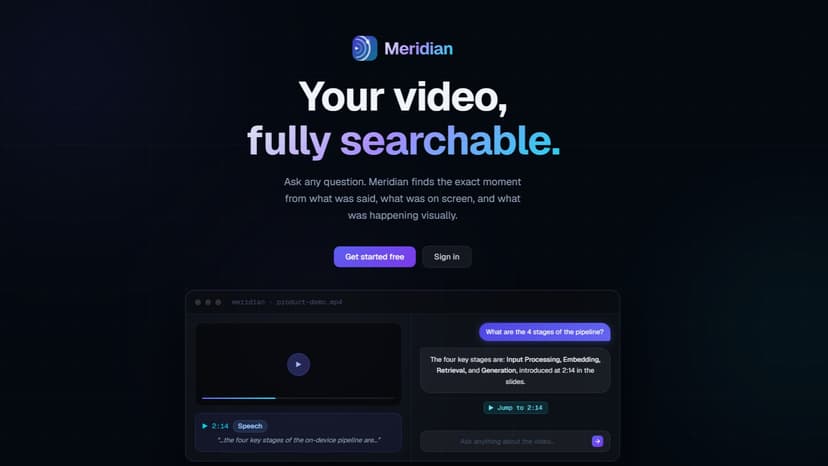
Video is one of the most information-dense formats that exists, but almost none of that information is actually accessible after the recording ends. You can scrub through a timeline, you can search a transcript if one exists, but if the answer to your question was written on a whiteboard, shown on a slide, or explained through a gesture without being spoken aloud, you simply cannot find it. Meridian was built to fix that. When you upload a video, Meridian processes it through three completely independent channels simultaneously. It transcribes everything that was spoken with precise word-level timestamps. It reads every frame for on-screen text, picking up slides, diagrams, formulas, and annotations. And it generates a full natural language description of the visual scene in every frame, capturing what the speaker is doing, pointing at, or drawing. When you ask a question, Meridian searches across all three of those knowledge stores at once and uses Gemini 2.5 Pro as an AI reasoning agent to identify the single moment in the video that best answers what you asked. The video seeks to that timestamp automatically. You also see exactly which source fired the strongest signal for that answer, whether it was the spoken word, the on-screen text, or the visual scene, so you can trust the result. The target audience is anyone who works with recorded video as a knowledge source: engineering teams reviewing architecture discussions, legal and compliance teams indexing regulatory training libraries, researchers cataloguing interview recordings, or enterprise teams making internal video knowledge bases actually searchable. Meridian makes the full content of any video as accessible as a well-indexed document.
19 May 2026


