.png&w=256&q=75)
Mannat Aggarwal@manana
1
Events attended
1
Submissions made
Looking for experience!
Socials
🤝 Top Collaborators
.png&w=640&q=75)
🤓 Latest Submissions
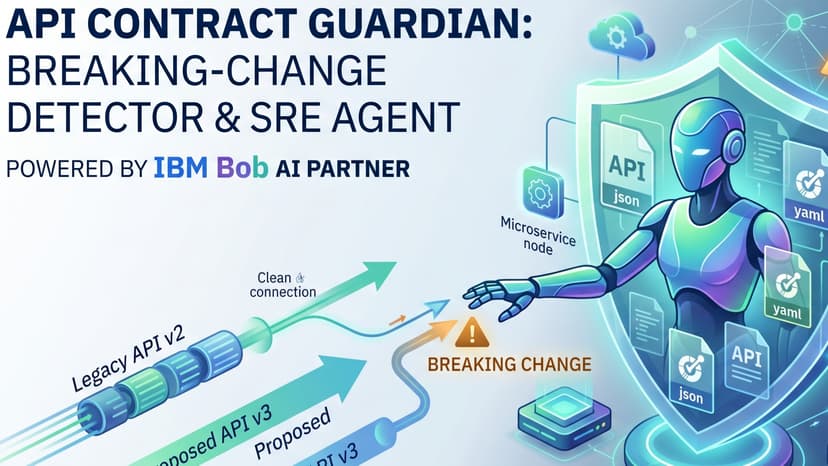
API Contract Guardian
The problem. Silent breaking API changes are one of the most expensive recurring failures in software. They pass code review — a reviewer sees a clean diff, not the downstream consequence. They pass tests — the API's own tests stay green; it's the consumer's tests, in a different repo, that would fail. They break in production, where another team discovers them hours later, mid-incident. Linters catch syntax and type checkers catch one repo, but nothing routinely answers the question that matters at commit time: does this change break the contract other teams depend on, and who is affected? The solution. API Contract Guardian answers exactly that. At commit time, it classifies every API change as BREAKING, SAFE, or REVIEW, and for every breaking change it returns the blast radius — which downstream consumers are affected and the exact files and lines. How IBM Bob is central. Bob operates at two levels. We ship a custom Bob mode and a custom MCP server as deliverables, and non-interactive Bob Shell runs inside the product as the live classification engine — Bob is the engine, not a side tool. The IBM Cloud stack. watsonx.ai (Granite) writes plain-English alerts, Cloudant persists verdict history, and watsonx Orchestrate routes each breaking change to the team that will break. Why it's different. API contract governance is an uncrowded niche, Bob runs inside the product rather than beside it, and the classifier scores 94.4% accuracy on a labelled test set. Scope is deliberately narrow — OpenAPI schema-level breaks only — which keeps the result honest.
17 May 2026
