
🤝 Top Collaborators


🤓 Latest Submissions
TruthLens AI
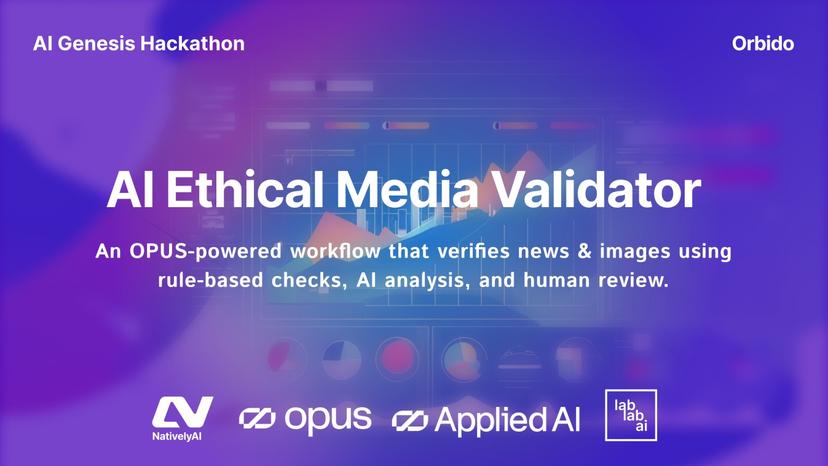
Every day, millions of people consume breaking news, Instagram reels,Tik Tok videos, tweets without realizing how much of it is AI-generated, manipulated, or misleading. As synthetic media becomes indistinguishable from reality, users lose the ability to verify what’s true. No universal verification layer exists—and trust is collapsing. TRUTHLENS AI is a next-generation Opus-powered workflow that restores transparency to digital content. It ingests multi-format sources (RSS feeds, Reddit posts, mock social media inputs) and analyzes each item through a chain of specialized AI agents that detect: • AI-generated or low-quality “AI slop” content • Manipulated or synthetic images • Misinformation and risky narratives • Suspicious linguistic or behavioral patterns • Factual claims requiring validation The system blends deterministic rules (required fields, thresholds, matching, formatting checks) with advanced LLM reasoning for categorization, summarization, and authenticity scoring. All processing is traceable and auditable, producing a step-by-step provenance record for every item. High-impact, ambiguous, or low-confidence cases automatically escalate to an Agentic Review Layer, followed by Human-in-the-Loop review for final validation—ideal for newsroom teams, policy analysts, or trust & safety units. Outputs include: • authenticity verdicts • risk labels • confidence scores • extracted evidence • external reference links • timestamps, IDs, and full audit summaries Final results are delivered to external destinations (e.g., Google Sheets, email, dashboards) with complete transparency. TRUTHLENS AI demonstrates an industry-ready approach to content authenticity, scalable moderation, and trust verification—fully automated through Opus while remaining human-accountable.
19 Nov 2025

Vibrational Analysis agent- coral protocol
The Bearing Vibrations Analyst is an AI-driven multi-agent system built on Coral MCP runtime to support predictive maintenance in rotating machinery. It integrates a set of modular agents that work together to process vibration data, detect bearing faults, and generate human-readable reports for maintenance engineers. The workflow begins with the Interface Agent, which provides a simple entry point for users. Engineers can upload vibration recordings in MP3 format along with an optional natural language prompt (e.g., “Check the status of the bearing”). This agent coordinates the full diagnostic pipeline by invoking specialized modules: a DataAgent to load and convert audio signals into mel-spectrograms, a PreprocAgent to normalize input, a ModelAgent (powered by a trained CNN classifier) to predict fault types, and a DecisionAgent to map predictions into actionable maintenance steps. Fault categories include Normal, Ball fault, Inner Race fault, and Outer Race fault. Once the diagnostic decision is produced, the Explain Agent generates a detailed, contextualized report. Leveraging Nebius AI’s large language models (e.g., gpt-oss-20b), the Explain Agent transforms raw predictions and decisions into clear, actionable guidance tailored for maintenance engineers. This removes the need for specialized vibration analysts to interpret raw signals, making the system usable by non-experts on the shop floor. Deployed as native STDIO agents with Coral SDK, both Interface and Explain Agents can be registered in Coral Studio and invoked through a shared registry. The system supports modular extension, meaning that more diagnostic agents (e.g., for gearboxes, pumps, or turbines) can be added without rewriting the pipeline. Overall, the Bearing Vibrations Analyst accelerates condition monitoring, reduces unplanned downtime, and empowers maintenance teams with clear AI-driven fault diagnostics and recommendations.
21 Sep 2025
Fashion AI
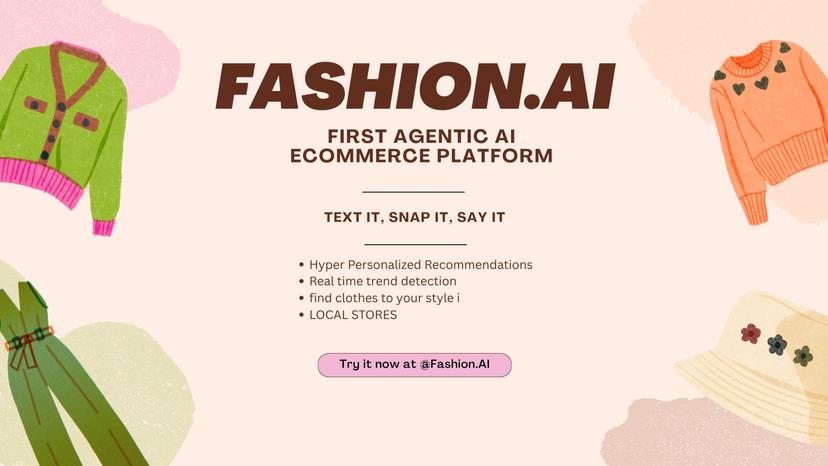
Fashion.AI is an intelligent, multimodal fashion e-commerce platform designed to revolutionize how users shop for clothing and style inspiration. Leveraging the power of agentic AI and advanced reasoning models, users can engage with the system via a conversational chatroom using text, images, or voice input. Unlike traditional search engines, Fashion.AI uses deep context awareness, object detection, and vector-based product matching to understand nuanced fashion queries such as: “Show me jackets similar to this one but in pastel tones, and suggest stores nearby.” The platform features an AI assistant that opens into a full-screen chatroom where the entire interaction happens. Here, the AI reveals its step-by-step thought process—analyzing queries, identifying visual elements, searching current trends, and surfacing product recommendations, all while allowing the user to chat, refine, and take action interactively. The homepage also showcases trending fashion items to keep users inspired even before querying the AI. All personalized suggestions, filters, maps, and style breakdowns remain fully contained within the chatroom, preserving a clean and focused UI. Fashion.AI bridges intelligent reasoning and real-time style discovery, offering an innovative blend of fashion, technology, and user experience.
8 Jul 2025


