🤝 Top Collaborators
.png&w=640&q=75)
🤓 Latest Submissions
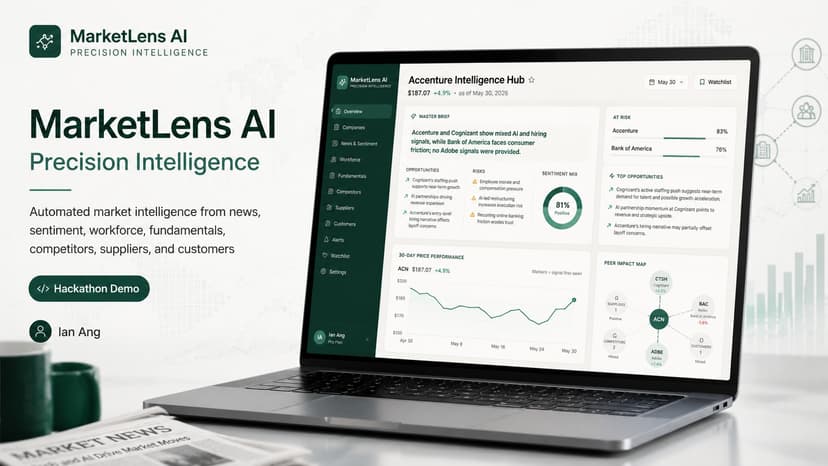
MarketLens AI
MarketLens AI is a real-time AI-powered intelligence platform designed to help finance, procurement, and risk teams detect supply chain bottlenecks, ecosystem risks, and market inefficiencies. Instead of relying on end-of-day feeds, static dashboards, or week-old research, the platform continuously monitors live web sources such as financial news, SEC filings, social discourse, and capacity signals as soon as they appear. At the core of MarketLens AI is a multi-agent orchestration system powered by seven specialized AI agents. The Ecosystem Agent discovers competitors, customers, and suppliers around any target company, building a broader view of the company’s operating environment. The Analyst Agent reads scraped news and extracts signals across five perspectives: financial, operational, social, regulatory, and competitive. When evidence is incomplete or weak, the Follow-Up Agent reviews the initial findings and re-scrapes deeper to strengthen the intelligence base. The Coordinator Agent then synthesizes ecosystem-wide risks and opportunities, connecting signals across companies, sectors, and supply chain relationships. To improve reliability, the Verification Agent fact-checks claims and rewrites insights that do not survive cross-source validation, reducing hallucination risk. The Propagation Agent models how disruptions may ripple from peers, suppliers, customers, or competitors back to the primary company. Finally, the Discover Agent turns the validated intelligence into a dashboard-ready view for users. MarketLens AI is powered by Bright Data. Bright Data’s SERP API captures news and market in real time, while Web Unlocker REST extracts full-page content. Datasets v3 streams social signals from X and Reddit for sentiment analysis. Together, these Bright Data primitives give MarketLens AI durable access to high-value sources that conventional scraping systems often cannot reach.
31 May 2026
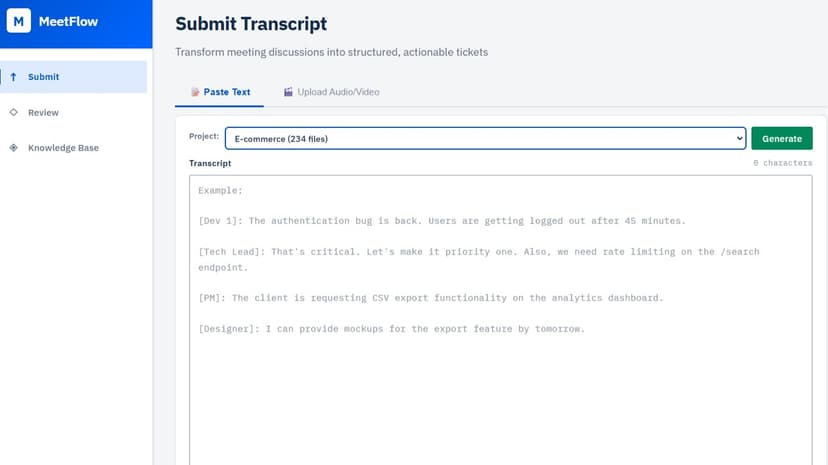
MeetFlow
MeetFlow eliminates bottleneck between team discussions and developer action. When meeting ends, decisions are fresh — but by the time someone writes a ticket, context has degraded. Developers receive vague tasks and waste hours clarifying requirements before writing a single line of code. This costs teams hours of back-and-forth every sprint. MeetFlow solves this by connecting conversations directly to codebase. Submit any text as input — meeting transcripts, Slack threads, chat logs, brainstorming notes, or requirement drafts — or upload an audio or video recording directly. MeetFlow's 2-pass LLM pipeline goes to work: Pass 1 scans the transcript to identify every action item and maps each one to relevant files using the indexed codebase. Pass 2 fetches the actual source code of those files and generates a detailed ticket grounded in real code — with exact file paths, function names, numbered implementation steps, acceptance criteria, and edge cases. The knowledge base indexes the entire repository, storing file metadata and source content in IBM Cloudant. Simply paste a GitHub URL to index any project instantly . Every ticket is written against codebase's real functions and patterns, not generic advice. A human reviews and approves each ticket in the web portal once AI generated. On approval, a Jira issue is created automatically with full bidirectional sync via webhooks — title/description changes in Jira reflect back in MeetFlow in real time. Once approved, developer using Bob IDE picks up the ticket via MCP configured. Bob fetches the full ticket details, reads the listed files, and implements the code following the exact steps. The developer stays in control throughout — reviewing Bob's plan before any code is written, and approving the final PR before merge. Built on IBM Cloudant, IBM Speech-to-Text, Azure OpenAI, and deployed on Azure App Service. From a 10-minute meeting to shipped code — no manual ticket writing required with maximised productivity.
17 May 2026

