.png&w=256&q=75)
🤓 Latest Submissions
Setu Guardian AI
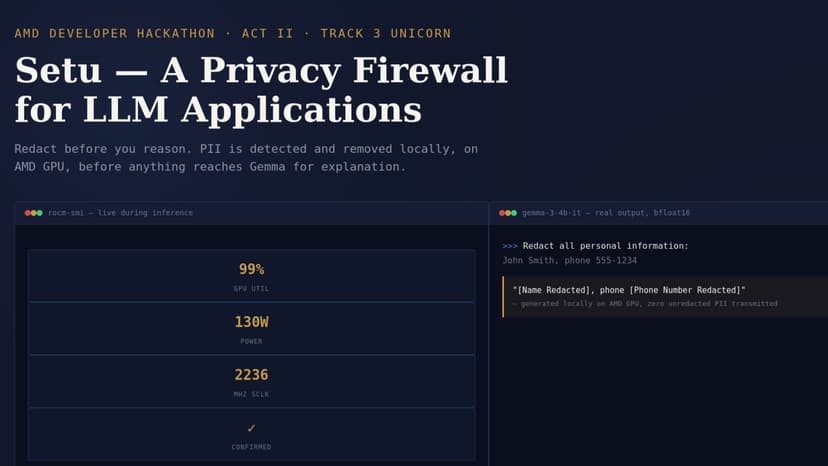
Setu is a privacy firewall for LLM applications: detect → redact → verify → explain. Millions of people receive documents — prescriptions, bills, government forms — they can't safely or easily understand, and existing "AI helper" tools require sending that sensitive content to a third party unredacted. Setu solves this differently. PII detection and redaction runs locally on an AMD GPU (confirmed via torch.cuda.is_available() = True, device "AMD Radeon Graphics", Navi31 architecture), using Gemma 3 4B-IT via PyTorch ROCm 6.2. Only the redacted transcript — with names, phone numbers, and ID numbers already replaced — ever crosses to the reasoning stage, which generates a plain-language explanation and regional-language translation. We verified real GPU utilization during inference: 99% GPU load, 130W power draw, 2236MHz clock speed, captured live via rocm-smi. Gemma 3 4B-IT was downloaded, licensed, and run directly on AMD hardware in bfloat16 precision, producing correct redaction output (verified against float16, which caused numerical instability on this architecture — a real ROCm/Navi31 compatibility finding). The redaction engine is built as a standalone, reusable component (gemma_guard), not app-specific code — proven by running it against unrelated documents outside the main demo flow. The document-explainer app is one proof-of-concept built on top of this middleware; the underlying pattern — redact before you reason — is intended to be reusable by any team building LLM applications on sensitive data. Self-verification (an independent re-scan of redacted output for leaks) and a downloadable SHA-256 verification receipt provide auditable evidence of what was and wasn't redacted, rather than asking users to trust an unverifiable claim. Built solo under significant time constraints, with an honest account of what's fully verified versus in-progress included in the project documentation.
13 Jul 2026
