.png&w=256&q=75)
🤓 Latest Submissions
Borderline
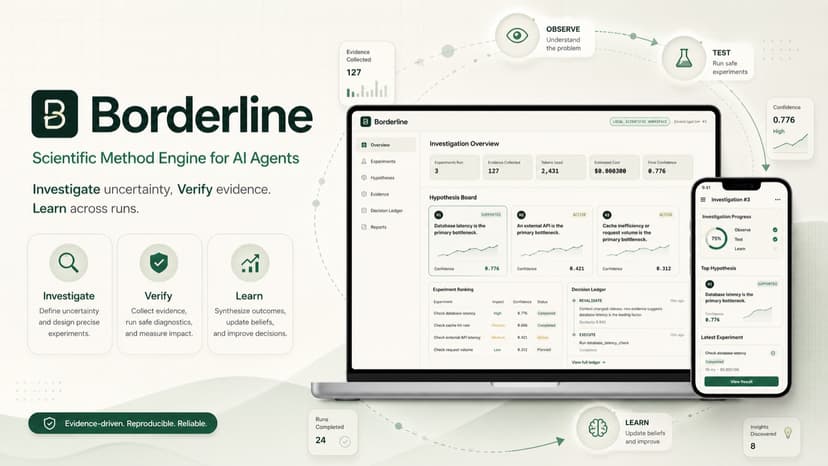
Borderline is a scientific reasoning and investigation engine designed to make AI agents more reliable when working on uncertain problems. Most AI agents are good at generating actions, but they may guess, repeat tool calls, follow weak assumptions, or restart similar investigations from zero. The Borderline introduces a structured scientific workflow between the agent and its tools. When given an uncertain problem, the system retrieves relevant past investigations, generates competing hypotheses, ranks possible experiments based on expected information value, safety, time, and cost, and runs the most useful test. It then records the evidence, updates confidence for each hypothesis, decides whether to continue or stop, and produces an auditable final report. The working prototype demonstrates this through an application-latency investigation. It checks possible causes such as database latency, external API latency, cache performance, and request volume. The system records every experiment and decision in a chronological ledger. The prototype also demonstrates reusable learning. On the first investigation, it ran three experiments. On a similar changed-context investigation, it retrieved the previous experience, recognized that the environment had changed, and revalidated the conclusion with only one experiment. This reduced estimated cost from $0.000300 to $0.000100 and recorded execution time from 30 ms to 10 ms. Borderline includes hypothesis generation, experiment ranking, evidence classification, confidence updates, budget controls, stopping rules, experience retrieval, revalidation, cost tracking, and a final scientific report. The project also validates open-source model inference on AMD GPU infrastructure using ROCm and a Qwen model. The long-term vision is to provide this reasoning layer through an API and an agent-native workspace where people can supervise multiple AI agents, review evidence, approve risky actions, and reuse learning across tasks.
13 Jul 2026
