
Kevin Silva Aguilar@kevinsilvaaguilar58026
1
Events attended
1
Submissions made
Chile
1 year of experience
About me
Electronic Engineering student passionate about Artificial Intelligence, Computer Vision, Embedded Systems and Healthcare Technology. I enjoy building practical AI solutions that improve accessibility and quality of life, especially in audiology and assistive technologies. I have experience developing Android applications, working with computer vision cameras, and participating in AI hackathons. Always looking for challenging projects where technology can create real-world impact.
🤓 Latest Submissions
SOCIELSA Hear
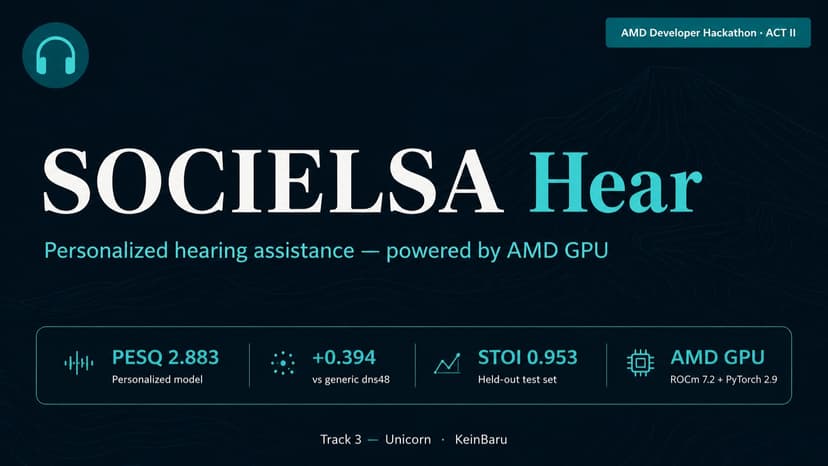
SOCIELSA Hear is a clinical hearing assistance tool built for the SOCIELSA audiology practice. It closes the loop between diagnosis and assistance: the audiologist already digitizes audiograms with SOCIELSA's existing tools — now those audiograms directly personalize how the patient hears. The system has three layers: (1) audiogram-based frequency compensation, deriving a personalized gain profile from the patient's hearing thresholds; (2) AI-powered voice enhancement using a fine-tuned dns48 denoiser, trained with an audiogram-weighted STFT loss that prioritizes frequency bands where the patient retains useful hearing; (3) keyword spotting via Whisper, letting users define words by text and get timestamped detections with visual transcript. The personalized model was fine-tuned on AMD GPU hardware (ROCm 7.2 + PyTorch 2.9) using a novel audiogram-weighted loss function. Evaluation on a held-out test set shows: STOI 0.953 vs 0.948 generic, PESQ 2.883 vs 2.489 generic (+0.394). Key finding: personalization benefit is proportional to the inter-frequency differential of the hearing loss — highest for sloping high-frequency loss, none for flat loss (audiologically coherent). Additional features include an in-browser audiogram digitizer (YOLO + Hough transform, ONNX, no backend required), and an AI clinical report generator using Gemma via Fireworks AI. The tool is designed as clinical assistance, never autonomous diagnosis. The audiologist always validates.
13 Jul 2026

