Karan Singh@karan_singh168
karan_singh168
🔥 Own Projects

🤓 Latest Submissions
Robot Abstraction
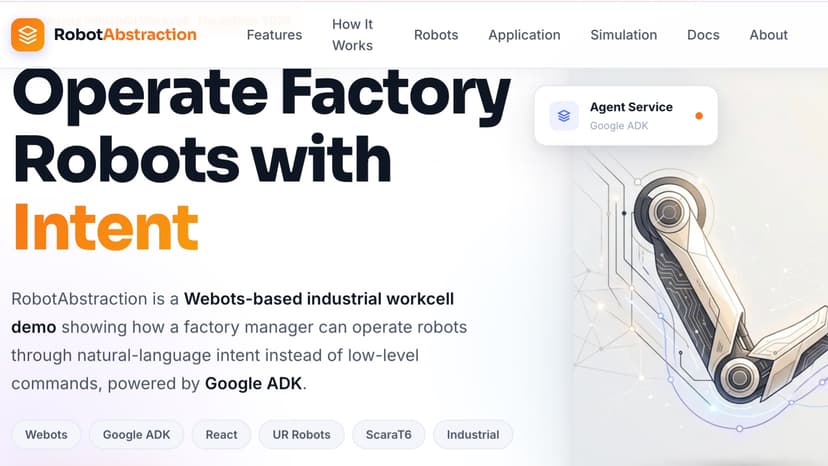
Robot Abstraction allows plant operators to convey their intent for plant objectives to multiple robots in a plant in natural language and for Gemini LLMs using Google ADK to translate into commands that a supervisor agent communicates with different real robots in simulators and the real world. Robot Abstraction enables - Multiple robots from different manufacturers with similar and different capabilities be used. Enables new robot manufacturers to get adoptions - Research institutions to envisage complex workflows that require orchestration to be built just by conveying human intent in natural language - Plant operators to test what if scenarios in simulation environments such as IsaacSIM, Gazebo and webots for their specific factory configurations before making buying decisions. Robot Abstraction is the interface between human intent and robot action through the robot abstraction framework. Robots are physical systems. Mistakes have real consequences. LLM outputs can be unsafe or incorrect. APIs are inconsistent across platforms. Simulations don't perfectly match hardware. Most teams end up rebuilding safety systems from scratch. Robot Abstraction addresses these issues in a simple framework that constrains to typed capabilities such as navigate, stop, inspect - validates actions through policies before execution and guarantees safety and correctness through guard rails. Robot Abstraction starts with simulation first developers and pick and place robots before we move to connecting with physical robots and to humanoid and drones
19 May 2026
.png&w=828&q=75)
RescueOrch - Orchestration platform for simulation
RescuOrch integrates Webots R2025a simulation with DJI Mavic 2 Pro drones, TIAGo++ ground robots and the Gemini 3 Flash LLM to orchestrate multi‑agent rescue operations. Its current demo tackles a kitchen fire, but the same platform can simulate active‑shooter drills, FEMA‑style flood recovery, massive fires in dense areas like Mumbai’s Dharavi, pipeline or oil‑rig accidents and high‑magnitude earthquakes. Gemini produces real‑time plans, so drones scout hazards, ground robots execute tasks and the plan adjusts as conditions change. These simulations address real gaps: U.S. fire‑response times average 6–8 minutes in cities and exceed 10 minutes in rural areas; Mumbai’s fire brigade reports response times of ~10 minutes in the city and 20 minutes in suburbs. Globally, over 180,000 people die from burn injuries each year and 86,473 people died in disasters in 2023. Last year 89 U.S. firefighters died on duty, underscoring the dangers responders face. After earthquakes, survival drops from about 90 % in the first day to 5–10 % after 72 hours, so rapid coordination saves lives. By running “what‑if” scenarios—larger or multi‑room fires, stronger earthquakes or multiple hazards—RescuOrch helps agencies test strategies and decide if additional drones or rugged robots would improve outcomes. With 27,000 U.S. fire departments and 23 oil refineries in India, there is a broad user base for physics‑based simulation training. In short, RescuOrch offers a versatile AI‑driven testbed to help responders plan, train and procure the right equipment for complex emergencies.
15 Feb 2026

Auto Treasury App
AutoTreasury is an autonomous, AI-powered invoice validation and payment system designed to streamline and secure business-to-business payments using blockchain technology. It eliminates the manual, time-consuming process of reviewing invoices and approving payments, while enforcing strict financial controls. The application operates as a two-step autonomous agent. First, users onboard approved vendors and define payment limits through a Streamlit-based interface. These limits act as guardrails that ensure payments remain within predefined thresholds. Second, users upload invoices directly into the system. An LLM automatically scans and extracts key invoice details, including vendor identity, invoice date, payment amount, and the recipient’s USDC wallet address. Once the invoice data is extracted, AutoTreasury performs a series of automated validation checks. It verifies that the vendor is pre-approved, confirms the invoice amount does not exceed the assigned payment limit, validates invoice dates, and ensures the USDC address is correctly formatted. Only when all checks pass does the system autonomously execute the payment using USDC on-chain via Circle and Arc. The Streamlit dashboard provides full transparency into payment activity, allowing users to easily track which invoices have been paid and which were rejected or flagged for review. This improves auditability, reduces fraud risk, and ensures compliance with internal financial policies. By combining AI-driven document understanding with programmable on-chain payments, AutoTreasury enables businesses to operate more efficiently, reduce operational risk, and execute payments instantly across borders and time zones. It offers a scalable, future-ready foundation for autonomous financial operations.
24 Jan 2026


