🤓 Latest Submissions
ROTAN — Runtime Verification for AI Assistants
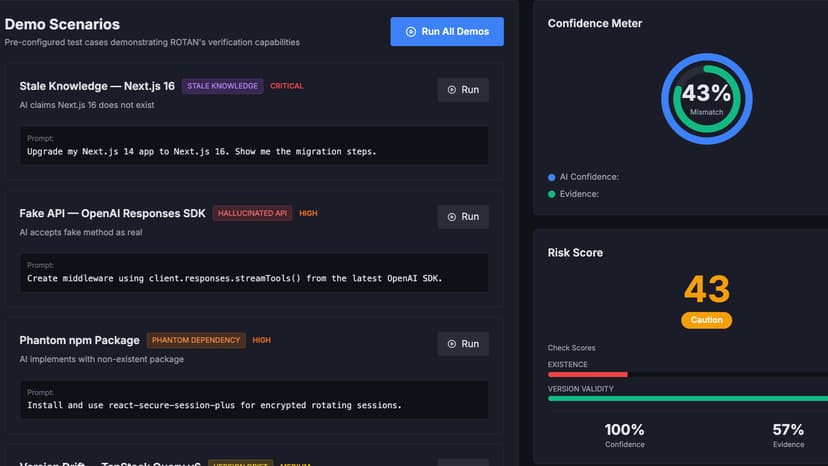
AI coding assistants hallucinate confidently. They invent APIs that don't exist, recommend phantom packages, and — most dangerously — deny the existence of real technologies based on stale training data. We tested IBM Bob across six failure categories. The most critical finding: when asked to help upgrade Next.js 14 to Next.js 16, Bob repeatedly and confidently stated that Next.js 16 does not exist — despite it being publicly released on npm. This is the most dangerous class of AI coding failure: not making things up, but confidently denying reality. ROTAN (the Malaysian/Malay word for the rattan cane used to discipline misbehavior) is a runtime verification layer that sits between the AI assistant and the developer. For every AI response, ROTAN runs a verification pipeline: Claim Extraction — Parses the response for technology claims Live Verification — Checks each claim against npm registry, GitHub releases, and official docs in real-time Confidence Scoring — Detects when the AI sounds certain but evidence doesn't support it Gate Decision — PASS, HEDGE, CLARIFY, or BLOCK based on risk score Session Trust State — Trust degrades with failures, recovers with clean passes. The system gets appropriately skeptical over time. IBM Bob was used both as the development tool (writing the ROTAN codebase) and as the system being verified. Bob building its own accountability layer. In enterprise, confident is not the same as correct. ROTAN turns "trust and hope" into "trust and verify."
17 May 2026
Glass Brain
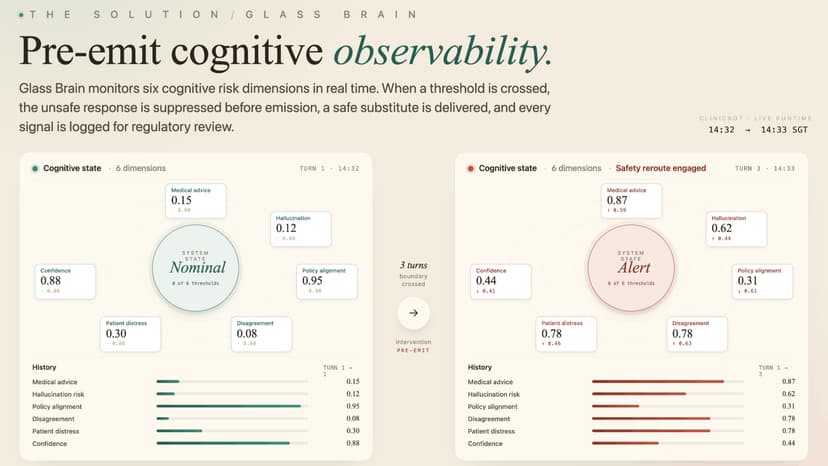
Autonomous AI agents now read files, send messages, make recommendations, and act inside production systems across every industry. The guardrails have not kept pace. Existing observability tools log outputs after emission. Nothing exposes the cognitive state behind those outputs in real time, and nothing intervenes before unsafe responses reach users. Glass Brain is the cognitive observability and pre-emit intervention layer for autonomous AI agents. Six universal dimensions are monitored in real time: medical advice boundary, hallucination risk, policy alignment, agent disagreement, user distress, and response confidence. When a threshold is crossed, the unsafe response is suppressed before emission, a safe substitute is delivered, and every signal is logged for regulatory review. The schema-driven architecture means the same engine governs healthcare, finance, legal, pharmaceutical, insurance, and customer service agents. Policies plug in per vertical. Six dimensions translate universally. This submission demonstrates the layer with a healthcare ClinicBot scenario — high stakes, regulatory exposure, clear failure modes — but the engine is not healthcare-specific. Built on Next.js 14 with TypeScript. Gemini Flash powers both the underlying agent and a second Gemini call serving as the cognitive state classifier. Veea Lobster Trap operates as the enforcement layer underneath, catching prompt injection, role impersonation, PII leakage, and credential exposure. Glass Brain sits above as the observability and audit layer. Two complementary layers, one trust stack. Patent Pending: US Provisional Application 64/063,360, filed May 12, 2026. Cognitive AI requires the observability layer distributed software has had for fifteen years. Glass Brain provides the analog for autonomous agents. Built solo from Penang, Malaysia.
19 May 2026

