
Juan Pablo Enriquez@jpablortiz96
7
Events attended
5
Submissions made
5+ years of experience
About me
I’m a developer passionate about building practical solutions with AI, software engineering, and scalable technologies. I enjoy turning ideas into working products, collaborating with teams, and learning fast in hackathon environments. I’m especially interested in creating impactful tools that solve real-world problems.
🤓 Latest Submissions
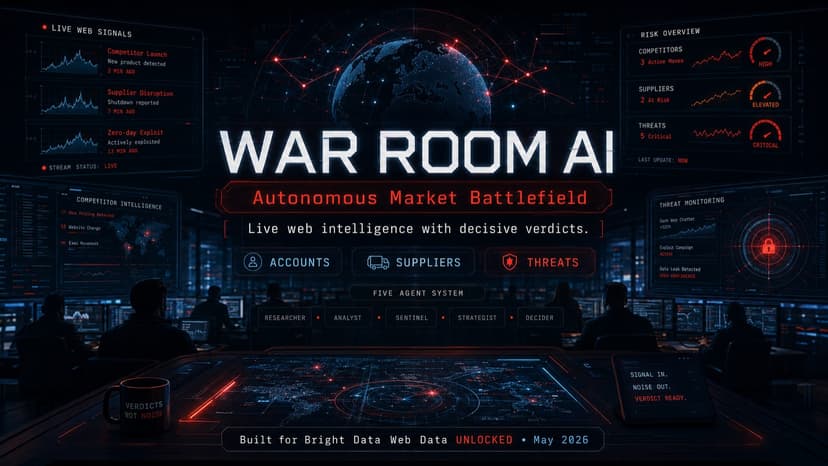
War Room AI — Autonomous Market Battlefield
War Room AI is an autonomous multi-agent intelligence platform that turns the live web into Executive Battle Briefs — decisive intelligence reports a Chief Strategy Officer could defend to a board. THE PROBLEM Every Fortune 500 has a competitive intelligence team. Most companies don't, because hiring one costs $400K per year. Sales teams react to competitor moves weeks too late. Procurement learns about supplier collapse from the news. Security teams discover threats only after disclosure. Perplexity gives one-shot answers. Bloomberg dashboards are stale. The signal exists in real time across the open web — but no agent can reliably reach it through bot detection, geo-blocks, JavaScript rendering, and rate limits. THE SOLUTION Five autonomous agents — Planner, Researcher, Skeptic, Verifier, Commander — collaborate via LangGraph to produce decisive intelligence in 15 seconds. The Researcher orchestrates ALL FIVE Bright Data products in parallel: - SERP API for cross-engine signal discovery - Web Scraper API for 660+ structured site extractors - Web Unlocker to bypass bot detection on press, IR, and trust pages - Scraping Browser for JavaScript-heavy enterprise targets - MCP Server for agentic navigation with Claude The Skeptic challenges every finding. The Verifier scores confidence per claim. The Commander synthesizes the Executive Battle Brief — Market Move Score 0-100, Recommended Move (ATTACK/DEFEND/ESCALATE/MONITOR/WAIT), Action Pack with specific next steps, and a rationale defending the call against the alternatives. THREE FLAGSHIP MISSIONS — ONE PER TRACK - Account Pulse (Track 1, GTM): Anthropic → DEFEND 72, Confidence 78 - Supplier Watch (Track 2, Finance): Boeing → DEFEND 72, Confidence 78 - Threat Surface (Track 3, Security): Change Healthcare → DEFEND 71, Confidence 78 BUSINESS MODEL Solo $99/mo · Team $399/mo · Enterprise custom. Cost per mission: ~$0.13. Margin: 92%. TAM: $14B across sales intel, supplier risk, threat intelligence.
31 May 2026
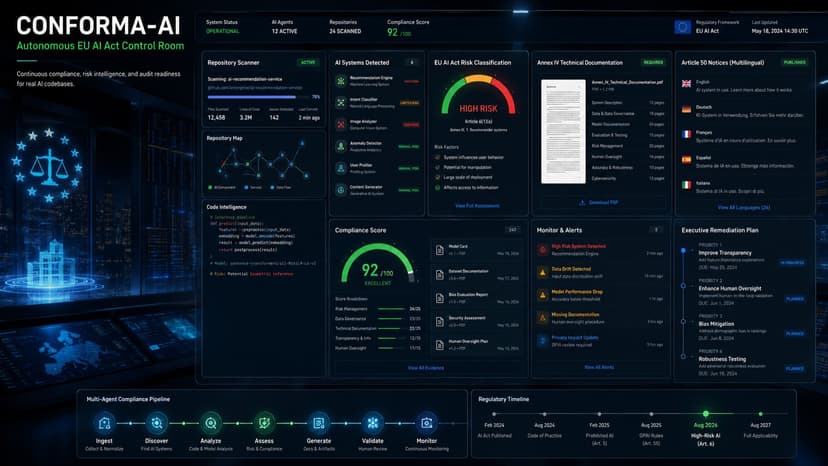
Conforma-AI: EU AI Act Control Room
Conforma-AI is an autonomous EU AI Act compliance control room for real AI codebases. Enterprises are shipping AI faster than legal, risk, and compliance teams can inventory it. AI risk now lives inside repositories, notebooks, model files, dependencies, prompts, and product workflows, yet most teams still rely on manual reviews, spreadsheets, and scattered documentation. Conforma-AI turns a repository URL into defensible compliance evidence. Its orchestrated agent pipeline scans the codebase, detects candidate AI systems, maps each system to EU AI Act obligations, generates Annex IV technical documentation for high-risk systems, creates multilingual Article 50 disclosure notices for generative AI, computes a compliance score, estimates scenario-based exposure, monitors regulatory deadlines, and produces a board-ready remediation plan. The platform is evidence-first: every decision is backed by source files, detection signals, legal mapping, generated artifacts, gaps, and agent traces. In production demos, Conforma-AI classified a real resume-screening repository as HIGH_RISK under Annex III Section 4(a), generated an Annex IV PDF, and identified remediation gaps. It also classified karpathy/llm.c under Article 50(2) and produced multilingual disclosure notices. Conforma-AI helps engineering, legal, security, and executives move from hidden AI risk to actionable governance in minutes, reducing manual triage, accelerating enterprise readiness, and creating a repeatable control process for AI regulation.
19 May 2026
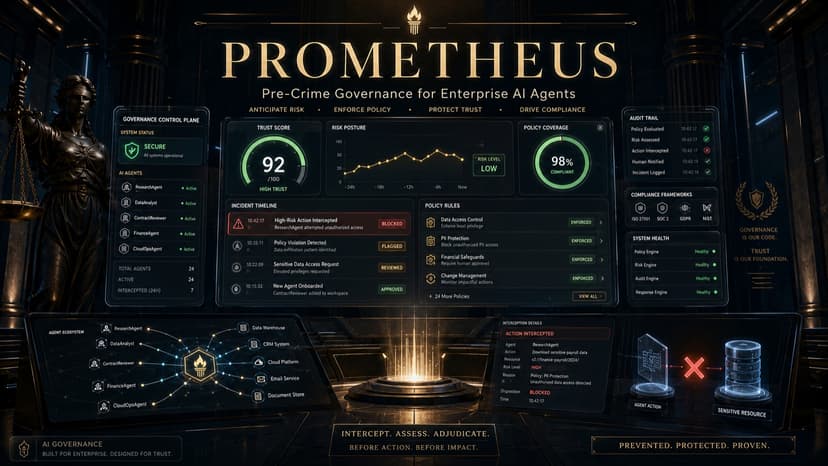
PROMETHEUS
PROMETHEUS is a pre-crime governance control plane for enterprise AI agents. As AI agents move from chat into real business action, they can query CRMs, read financial data, summarize contracts, send emails, index documents, and trigger internal workflows. That creates a new enterprise risk: an agent may declare a safe intent, but attempt a dangerous action before security teams can see or stop it. PROMETHEUS sits directly in the execution path as an Agent Tool Gateway. Before an agent can use a tool, the system inspects the prompt, payload, declared intent, detected intent, permissions, policy match, and risk score. It then decides whether to allow, block, quarantine, or route the action to human review. The prototype uses Veea Lobster Trap in live CLI mode as the deep prompt inspection layer and Gemini as the reasoning layer for expected action prediction, tribunal-style decision support, threat intelligence extraction, and audit-ready explanations. PROMETHEUS also includes a permission matrix, Scenario Lab, Document Attack Lab, Audit Bundle, Regulator Report, and Zero-Day Sentinel, which turns emerging AI threat reports into safe policy simulations and proof that dangerous tools like exploit.generate are blocked before execution. PROMETHEUS is designed for CISOs, compliance teams, AI operations teams, and regulated enterprises that need to deploy AI agents with visibility, control, and defensible audit evidence.
19 May 2026
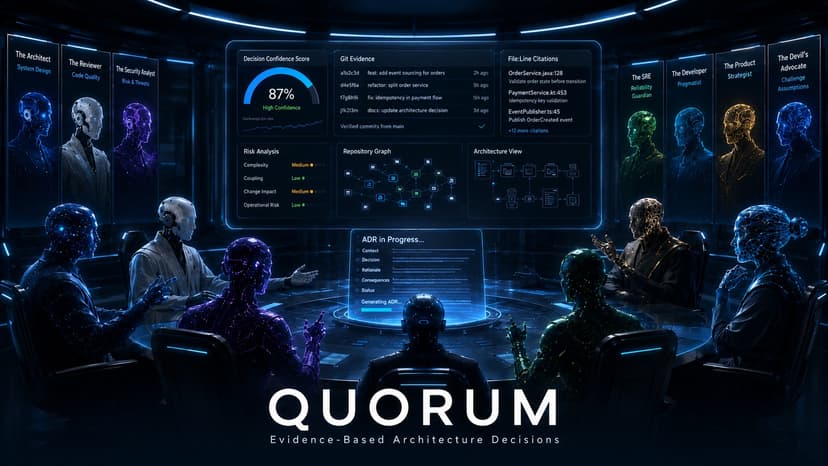
QUORUM: AI Architecture Tribunal
QUORUM is an adversarial AI tribunal for high-stakes software architecture decisions. Instead of asking a single chatbot for advice, developers convene a structured council of 7 specialized IBM Bob agents: Conservative, Reformer, Historian, Economist, Risk Officer, Engineer, and Judge. Each agent has an opposing mandate and must support its arguments with real repository evidence such as file:line citations, commit hashes, dependency impact, historical precedents, and economic trade-offs. The system runs a multi-round debate, including cross-examination between opposing agents, then produces a Decision Confidence Score and a committable Architecture Decision Record. QUORUM turns architecture decision-making from opinion-driven meetings into evidence-based, reproducible, and auditable engineering governance. It helps teams avoid costly technical debt, preserve institutional knowledge, and make better decisions before implementation — not after the damage is done. The project is built with IBM Bob custom modes, skills, slash commands, and a custom MCP server, plus a Next.js dashboard for visualizing repository health, council debates, DCS scores, evidence, and ADR history.
17 May 2026

ROCm AgentOps
ROCm AgentOps Command Center is an operational assurance layer for AI agents running on AMD-backed inference infrastructure. Instead of treating an agent as a black box, the system scores incidents deterministically, detects risk flags, calculates trust and confidence, routes work to the right execution path, and generates audit-ready outputs. The platform ingests business incidents, live AMD/vLLM workload signals, endpoint health checks, benchmark evidence, and optional ROCm/GPU telemetry. It then compiles each workflow into a safe execution plan: deterministic rules for low-risk cases, smaller-model summaries where speed matters, Qwen 7B through an OpenAI-compatible vLLM endpoint for higher-risk critique and narrative, and human review for critical or low-trust incidents. The Command Center includes a Model Router, What-if Strategy Simulator, Agentic SLA Monitor, Policy-as-Code guardrails, owner-aware escalation packets, SHA-256 audit seals, War Room Packet export, and a Build-in-Public telemetry card. In our validated AMD/vLLM run, Qwen/Qwen2.5-7B-Instruct achieved 20/20 successful benchmark requests, with live incidents generated from benchmark p95 latency evidence. The goal is to make AI agent workflows more trustworthy, auditable, cost-aware, and operationally useful for real teams—not just impressive demos.
10 May 2026


