🤝 Top Collaborators
.png&w=640&q=75)
.png&w=640&q=75)
🤓 Latest Submissions
VSAE: Surgical AI Knowledge Removal
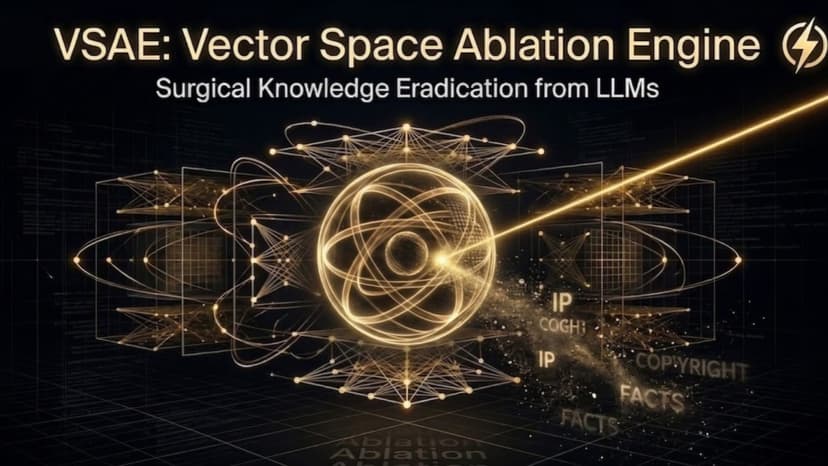
Enterprise AI faces a massive compliance problem: how do you make a trained LLM "forget" copyrighted IP, sensitive data, or toxic behavior without spending millions to retrain the foundational model from scratch? Vector-Space Ablation Engine (VSAE) solves this by acting as a surgical "delete button" for AI models. Instead of relying on fragile prompt engineering or basic RAG filters, VSAE mathematically scrubs specific concepts directly from the model's weights using orthogonal projection on attention layers. We successfully demonstrated this locally on the Phi-2 model. To transition this from theoretical math to an enterprise-ready product, we engineered a highly fault-tolerant safety architecture around the core ablation engine: 1. CascadeFlow (Self-Healing System): Editing model weights is risky. Our engine actively monitors post-ablation perplexity. If a deletion degrades the model's general language skills, VSAE automatically rolls back the matrix weights and recursively shifts to different neural layers (±2) to hunt for a safe topological neighborhood to execute the deletion. 2. Semantic Hindsight Memory: We integrated the Hindsight API to act as our memory archivist. It tracks past ablations and flags semantic overlaps (e.g., warning the user if they try to delete "Harry Potter" after already deleting "J.K. Rowling") to prevent catastrophic interference. 3. Offline Resilience: Built for zero-downtime environments, VSAE features graceful degradation. If cloud memory APIs time out or drop, the system automatically intercepts the network failure, falls back to local JSON logs, and executes the ablation offline without crashing. 4. IBM BOB Integration: We heavily utilized IBM BOB throughout our workflow to accelerate our backend engineering, rapidly debug matrix math, and ensure our API architectures were clean and production-ready.
17 May 2026


