.png&w=256&q=75)
🤝 Top Collaborators
.png&w=640&q=75)
🤓 Latest Submissions
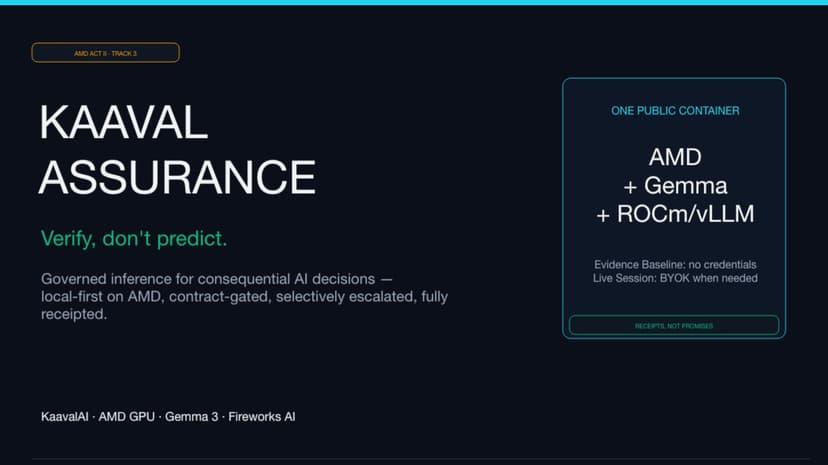
Kaaval Assurance: Verify, Don’t Predict
Kaaval is the control gate between enterprise AI models and real-world actions. It sits after a model generates and before software acts, checking every response against explicit company policy, escalating failures, and producing an audit receipt for every decision. The submitted Kaaval Assurance stack uses Gemma 3 as a local open-weight tier running on measured AMD hardware through ROCm and vLLM. Layer 1 applies deterministic task contracts covering required fields, enums, ranges, structure, and grounding rules. Responses that fail these checks are withheld and can be escalated selectively to Fireworks. Layer 2 tracks repeated contract failures using an exponentially weighted moving average, allowing routing policy to adapt as reliability changes. Layer 3 provides a sampled, calibration-gated audit signal; in this build it is display-only and is not presented as semantic truth. Every attempt produces a replay-able Kaaval Receipt containing the provider, model, contract, check results, routing reason, latency, tokens, cost basis, and runtime provenance. A React and TypeScript Flight Deck backed by FastAPI, Pydantic, and SQLite exposes the evidence through two modes: a credential-free Evidence Baseline and a Live Session for connected model endpoints. The complete application is packaged as a public Linux container that boots without secrets or downloading model weights. The AMD/Gemma execution evidence and Fireworks cost comparison are captured as separate, source-tagged artifacts. Kaaval claims contract conformance—not universal correctness—and keeps unavailable evidence explicitly unavailable.
13 Jul 2026
