.png&w=256&q=75)
🤓 Latest Submissions
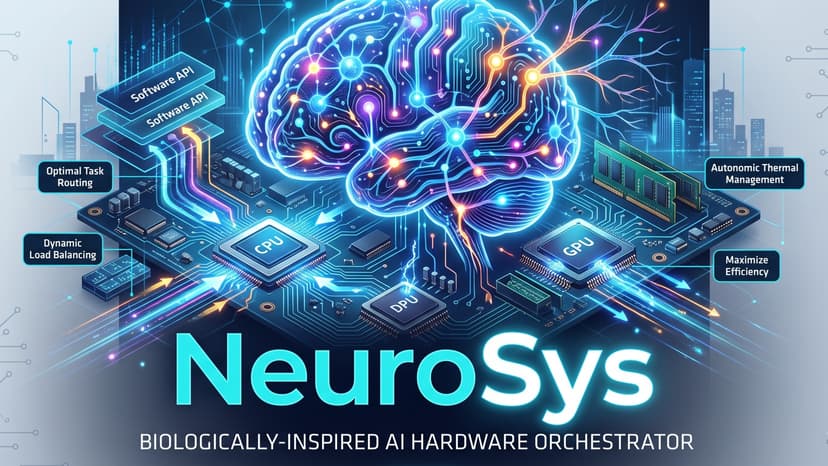
Solo-Rock-Matrix-Engine-NeuroSys
The Problem While modern CPUs, GPUs, and DPUs offer massive compute power, the software-hardware bridge is inefficient. During peak loads, software runtimes often misinterpret natural latency as dropped requests. This triggers redundant execution commands, creating a destructive loop: instruction cache flooding, severe thermal spikes, and excessive power draw that throttle system performance. The Solution NeuroSys is an open-source AI orchestrator acting as a cognitive middle-layer between software APIs and hardware SDKs. Modeled after the human nervous system, it functions as an intelligent load-balancer to eliminate software redundancy loops. Operating safely within authorized manufacturer APIs (like AMD ROCm and native OS telemetry), it optimizes hardware to sustain 100% of its designed potential without triggering thermal throttling. Architectural Features Central System (Brain): Dynamically analyzes workloads and maps live hardware topology. It strictly routes parallel mathematical tasks to the GPU while reserving sequential logic for the CPU. Peripheral System (Sensory/Motor): Acts as an intelligent pacing engine. Instead of letting software flood the hardware, it intercepts, batches, and feeds instructions at the exact rate the hardware can efficiently process. Autonomic System (Power/Thermal): Monitors background OS telemetry (temperatures, power limits). Upon detecting thermal spikes, it instantly signals the Central System to reroute non-critical tasks or adjust batching rates to maintain absolute stability. Target Audience Designed for high-performance computing (HPC) engineers, enterprise cloud administrators, and AI developers, NeuroSys maximizes AMD hardware utilization, eradicates thermal bottlenecks, and drives massive energy efficiency for intensive workloads.
13 Jul 2026
