🤝 Top Collaborators
🤓 Latest Submissions
Metis
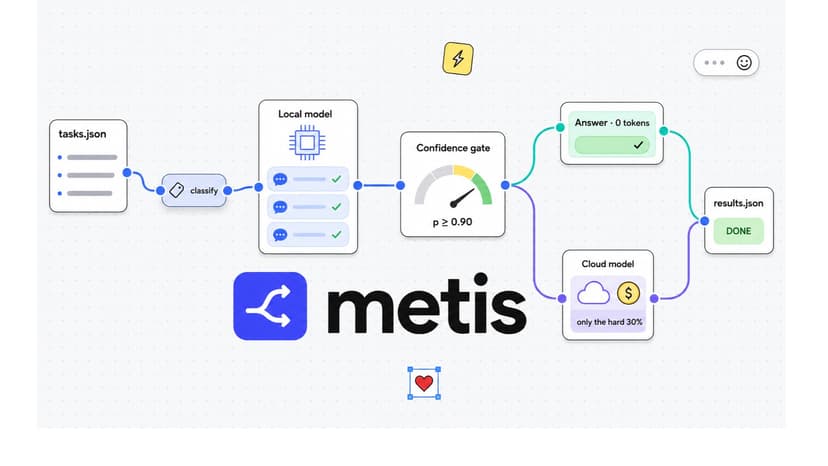
▎ Metis is a general-purpose AI agent built on one thesis: most tasks don't need a frontier model, and the ones that do should be identified before you pay for them — not after. ▎ ▎ Every task first runs on a small quantized model (Qwen2.5-3B) baked into the container, executing locally at zero API cost. Metis samples the local model several times in parallel and measures agreement: consistent answers across independent samples are strong evidence of correctness. That evidence — consensus, token-level confidence, and per-category signals — feeds an isotonic-calibrated confidence gate fitted on real observations. Only when the gate predicts the local answer would miss the accuracy bar does Metis escalate to a paid Fireworks model, chosen per task category with reasoning effort tuned so escalations cost single-digit tokens where possible. ▎ ▎ Known-hard categories (multi-step math, entity extraction) are force-escalated based on measured failure data, math gets a program-aided verification pass first, and an adaptive governor watches the runtime budget and downshifts sampling if the clock runs short. The whole system degrades gracefully: any failure at any layer falls back to the next-best answer rather than crashing. ▎ In our full 48-task rehearsal, Metis hit 95.8% judged accuracy while escalating only 29% of tasks — spending just ~1,400 total paid tokens, versus tens of thousands for a naive route-everything-to-the-cloud agent at comparable accuracy.
13 Jul 2026
Elixire
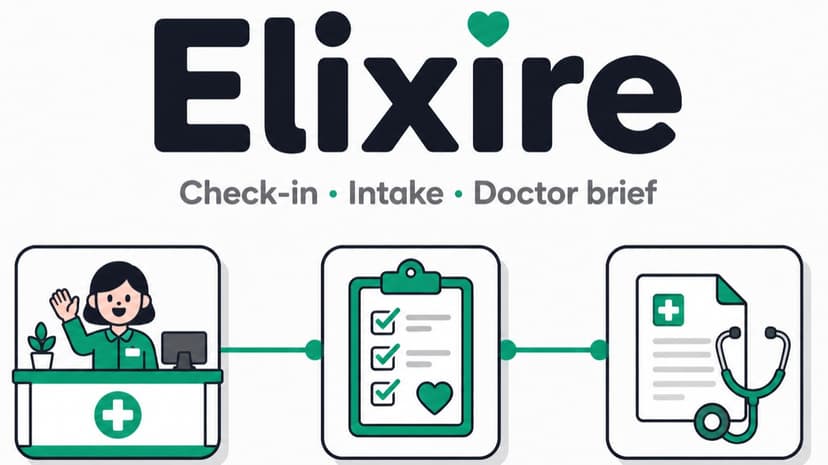
Solo clinic doctors lose 15+ minutes per patient on intake paperwork before they ever examine anyone. Elixire fixes that with a clinic operating system powered by three Band-coordinated AI agents. Patients check in through a friendly chat portal. The Receptionist agent validates identity and routes the visit. The Intake agent runs doctor-configured clinical protocols — asking specialty-specific questions, processing uploaded documents, and pausing for human-in-the-loop follow-ups when information is incomplete. The Brief agent generates a structured pre-visit summary so the doctor walks into the room already prepared. Band is the coordination backbone: each patient session gets an isolated chat room where agents hand off structured JSON via @mentions — every step is observable and auditable, not buried in a single opaque LLM chain. Safety is built in, not bolted on. A deterministic emergency gate triggers crisis resources before any LLM call. Intake never diagnoses — it only collects. Prescription drafts pass through AI/ML API verification for drug interactions and contraindications. Doctors configure intake per specialty (general practice, ophthalmology, cardiology, dental) via JSON clinic protocols — no code changes required. Elixire is your AI front desk, intake nurse, and medical scribe — coordinated by Band, ready before the patient enters the exam room.
19 Jun 2026
Gurren - Copilot for Development
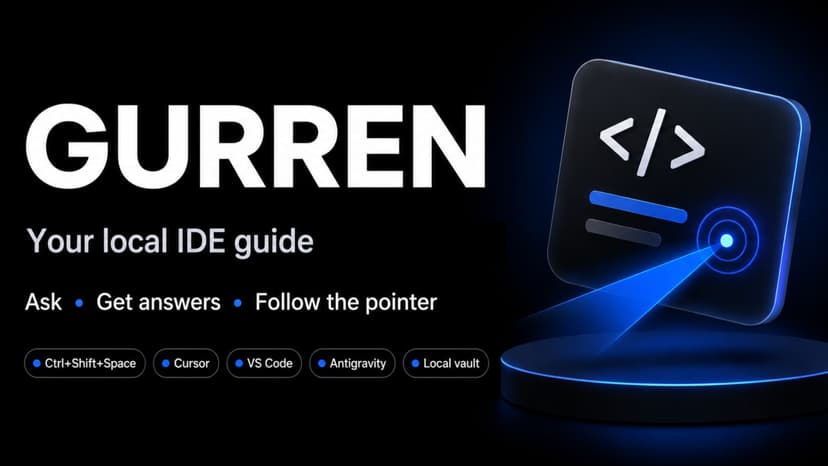
Modern IDEs are powerful but overwhelming. New features hide behind menus, shortcuts differ between tools, and generic chatbots hallucinate steps or ignore which editor you actually have open. Gurren is a Windows desktop copilot built for developers who live in Cursor, Visual Studio Code, or Google Antigravity. Press Ctrl+Shift+Space anywhere in your workflow to open a lightweight panel. Ask natural-language questions—“How do I open the command palette?” or “Where is GitHub Copilot?”—and get answers grounded in a curated markdown vault, not random web guesses. Gurren detects your active IDE and file context automatically, then routes each question through a three-tier retrieval pipeline designed for speed and privacy: • Level 1 — Instant tag lookup over a pre-built index for common questions with zero latency. • Level 2 — Semantic search with ChromaDB and local embeddings (Transformers.js) over hundreds of structured vault notes scraped from official docs. • Level 3 — Optional escalation to Anthropic Claude when the vault is not confident, including a dedicated PRD/spec mode that turns product requirements into IDE-specific build guides. When an answer references a UI control, Gurren draws an on-screen pointer overlay on top of your desktop so you know exactly where to click. A persistent memory layer writes usage patterns to vault/user (profile, history, unknown queries) so the assistant improves with you over time. The stack is Electron + React + TypeScript on the front end, Python scripts for vault seeding and indexing, and ChromaDB running locally—routine answers work offline; only Level 3 needs an API key. Gurren is local-first, context-aware, and built for real IDE workflows—not another browser tab.
17 May 2026


