Inseok Seo@gemsquared
3
Events attended
3
Submissions made
Korea, Republic of
10+ years of experience
About me
I’m Inseok “David” Seo, founder of GEM Squared, Inc. I’m building GEM² — an Autonomous AI Operating System for contract-based workflow management, AI audit, and governance of autonomous agents. The core idea is simple: AI agents should not just act. Their workflows, outputs, handoffs, and failures should be auditable. I created TPMN-PSL and TPMN-SKILL to turn AI work into explicit contracts of the form: STATE A → STATE B | Preconditions With GEM², agent workflows can be planned, executed, verified, archived, searched, and reused as contract-bound work records. The system audits whether AI outputs are grounded, inferred, drifting, overclaiming, at risk of hallucination, crossing scope boundaries, or losing constraints through compaction. My focus is moving AI engineering beyond vibe-coding toward computable, provable, reliable, and traceable autonomous AI operation. For this hackathon, I’m focused on Agent Security & AI Governance / Security & Trust: audit trails, policy enforcement, drift detection, invalid handoff detection, and enterprise-readable governance reports for autonomous agents. Live audit demo: https://gemsquared.ai Open spec: https://github.com/gem-squared/tpmn-psl TPMN Skill: https://github.com/gem-squared/tpmn-skill
🤝 Top Collaborators

.png&w=640&q=75)
🤓 Latest Submissions
LedgerLens
LedgerLens is a trust-gated verification layer for autonomous agent commerce. A buyer agent requests web data. A seller agent makes a claim. Before any payment is allowed, LedgerLens uses Bright Data to collect live public-web evidence, then sends the evidence and seller claim through the GEM² Trust Gate. If the claim is grounded, LedgerLens approves an x402-shaped simulated settlement. If the claim is stale, partial, overclaimed, or unsupported, LedgerLens blocks the payment and exports an audit bundle. The demo supports live judge requests, deterministic replay cases, Bright Data evidence receipts, L1/L2 GEM² audit scores, final reports, and read-only audit bundles. LedgerLens targets Track 3: Security & Compliance by solving third-party claim risk before autonomous spend. It also overlaps with Finance & Market Intelligence through supplier/vendor risk, spend policy enforcement, and audit-ready payment records. We simulate settlement for public demo safety: no private keys, no Coinbase account, and no real funds. The payment rail is simulated, but the trust gate is real. No grounded claim, no payment.
31 May 2026
GEM²-Crafter: Edge-Coding Orchestrator
GEM² Audit OS is an AI governance system for enterprises that need autonomous agents to act safely, explainably, and within auditable boundaries. In most AI workflows, humans are asked to manually review outputs after the fact. GEM² changes the control model: humans define the contract edge, and the system audits AI behavior at that edge. Each agent action becomes a contract-bounded transformation: `F: A → B | P`. Before execution, an input audit checks whether the runtime input satisfies the contract. After execution, an output audit verifies whether the result is grounded, compliant, and safe to continue. For security, GEM² integrates Lobster Trap as a governance gate: suspicious, unsafe, or policy-breaking behavior is trapped before it propagates through the workflow. For contract-based governance, Gemini is used as an audit intelligence layer, evaluating whether each step satisfies the declared contract, evidence, and postconditions. The result is not just an AI answer, but a regulator-readable audit record. The demo shows a four-layer audit page: contract definition, execution trace, security/governance gate, and evidence-backed audit verdict. GEM² is built for AI governance at the edge: AI can act autonomously, but every action must cross a verifiable boundary. Humans do not manually audit every decision; they define the rules, and GEM² produces reusable evidence for trust, compliance, and accountability.
19 May 2026
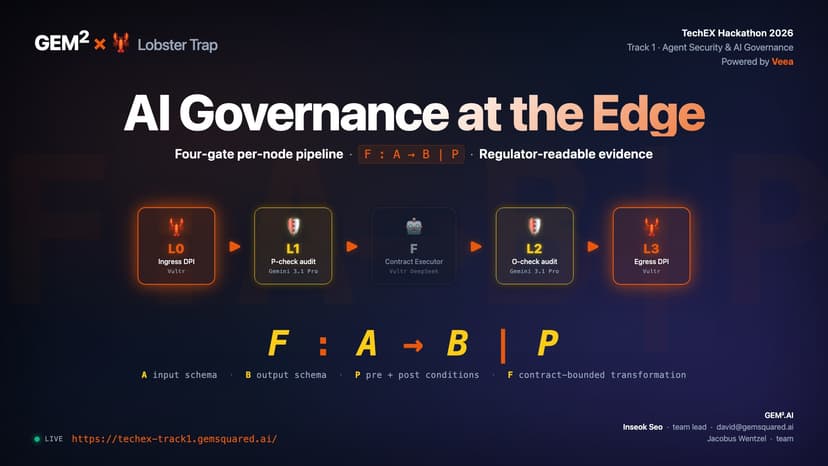
GEM² — AI Governance at the Edge
GEM² Audit OS is an AI governance system for enterprises that need autonomous agents to act safely, explainably, and within auditable boundaries. In most AI workflows, humans are asked to manually review outputs after the fact. GEM² changes the control model: humans define the contract edge, and the system audits AI behavior at that edge. Each agent action becomes a contract-bounded transformation: `F: A → B | P`. Before execution, an input audit checks whether the runtime input satisfies the contract. After execution, an output audit verifies whether the result is grounded, compliant, and safe to continue. For security, GEM² integrates Lobster Trap as a governance gate: suspicious, unsafe, or policy-breaking behavior is trapped before it propagates through the workflow. For contract-based governance, Gemini is used as an audit intelligence layer, evaluating whether each step satisfies the declared contract, evidence, and postconditions. The result is not just an AI answer, but a regulator-readable audit record. The demo shows a four-layer audit page: contract definition, execution trace, security/governance gate, and evidence-backed audit verdict. GEM² is built for AI governance at the edge: AI can act autonomously, but every action must cross a verifiable boundary. Humans do not manually audit every decision; they define the rules, and GEM² produces reusable evidence for trust, compliance, and accountability.
19 May 2026


