.png&w=256&q=75)
🤓 Latest Submissions
SentinelAI
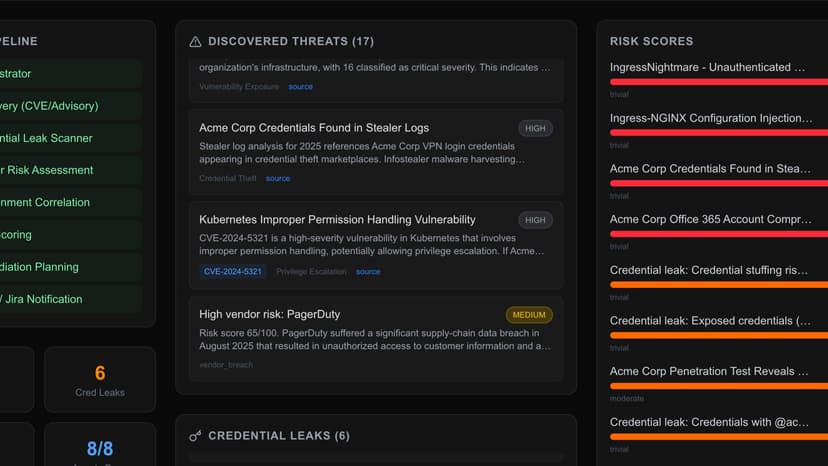
SentinelAI is an autonomous infrastructure threat intelligence agent that bridges the gap between the open web and your infrastructure. It uses Bright Data's SERP API, Web Unlocker, and Scraping Browser to continuously scan for Kubernetes CVEs, AWS security advisories, credential leaks on paste sites, and third-party vendor breaches. What makes it different: it doesn't just scrape — it thinks. Built on LangGraph with Claude Opus 4.6, SentinelAI deploys six specialized AI agents in parallel. The Discovery Agent hunts CVEs. The Credential Leak Agent searches paste sites and code repositories. The Vendor Risk Agent assesses your supply chain. Then the Correlation Agent matches every finding against your actual Kubernetes cluster versions, Terraform state, and AWS resources to determine what actually affects you. Threats that match your environment get scored by blast radius, exposure, and exploitability — not just CVSS. High-severity findings trigger the Remediation Agent, which generates exact kubectl commands, Terraform patches, and Helm upgrades. Finally, the Notify Agent sends Slack alerts and creates Jira tickets automatically. The entire pipeline runs on a production-grade stack: Docker Compose with Kafka event bus for auditable event streaming, PostgreSQL for persistence, and Server-Sent Events for real-time dashboard updates. Enter a company name, and watch the agents investigate in real time.
31 May 2026
Red Cell Pen test AI agent
Red Cell is an AI-powered autonomous penetration testing agent built on the Temporal workflow engine. It orchestrates end-to-end security assessments by combining real offensive security tools — Nmap, Nuclei, Subfinder, Httpx — with LLM-driven reasoning to discover, analyze, and verify vulnerabilities across target infrastructure. The agent progresses through a 14-state workflow: accepting natural language target definitions, enumerating subdomains and assets, mapping the attack surface with port scanning and API discovery (OpenAPI, GraphQL, REST), gathering real-time threat intelligence, and performing AI-driven vulnerability analysis. At its core, an agentic loop lets the LLM observe responses, reason about what to test next, and execute security checks autonomously — enabling discovery of business logic flaws, attack chains, and novel vulnerability patterns beyond what template-based scanners catch. Human approval gates ensure high-impact exploits require explicit authorization before execution. A built-in memory and learning system stores successful techniques and payloads, improving effectiveness across engagements. Comprehensive reporting delivers executive summaries, technical findings with reproduction steps, and remediation guidance
7 Feb 2026


