.png&w=256&q=75)
🤓 Latest Submissions
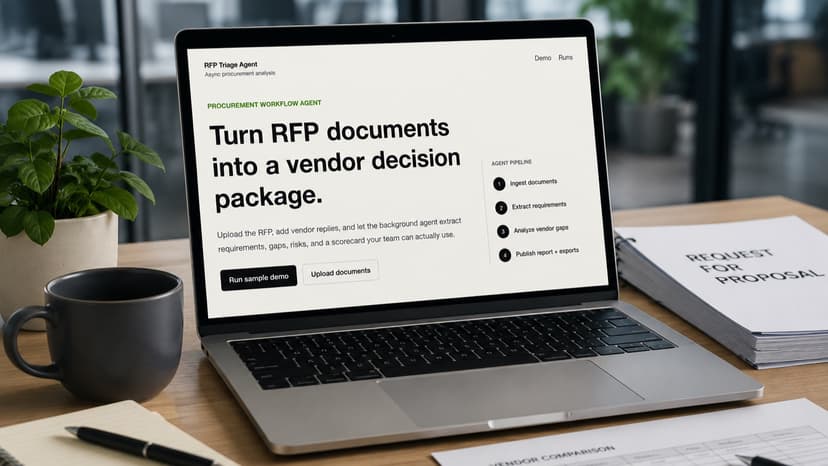
BidLens: RFP Decisions, Clarified
BidLens is an async AI workflow for enterprise procurement teams that need to evaluate RFPs and vendor responses faster. Instead of manually reading long PDFs, teams upload an RFP and optional vendor reply documents, then BidLens queues a background run that extracts requirements, analyzes vendor coverage, identifies risks, and produces a decision-ready package. The output includes a readable Markdown report, structured JSON, and a CSV scorecard that can be shared with managers or reused in downstream systems. BidLens uses Featherless through an OpenAI-compatible API, making it easy to swap open-source models without managing GPUs. It is designed as a practical, production-shaped agentic workflow rather than a generic chatbot.
19 May 2026
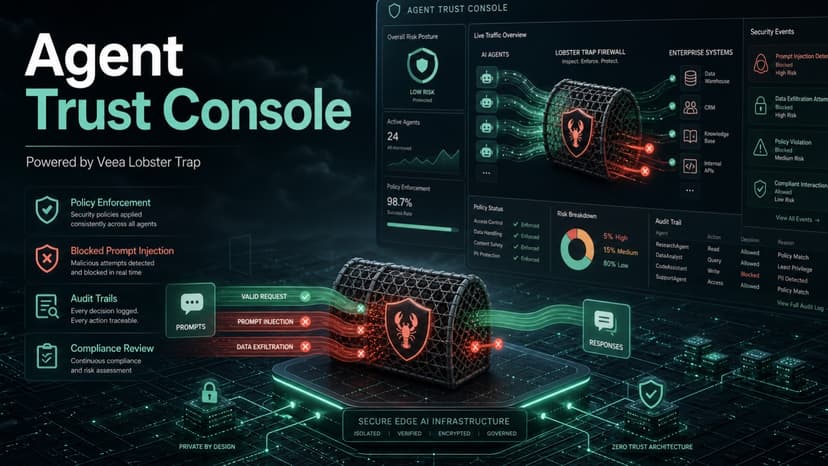
Agents for Compliance
Agent Trust Console is a trust and governance demo for enterprise AI agents, built on Veea’s Lobster Trap deep prompt inspection (DPI) proxy. As agents gain the ability to read files, call APIs, send messages, and trigger real actions, a single prompt injection can cause credential leakage, PHI/PII exfiltration, or unsafe operations. Most teams still lack visibility into what agents are doing and proof that guardrails actually worked. Lobster Trap sits between your agent app and any OpenAI-compatible LLM backend, inspecting every prompt and response and extracting structured metadata: detected intent, risk scoring, PII/credential signals, injection and exfiltration patterns, target domains/paths, and the matched policy rule. It enforces programmable YAML “firewall” policies with actions like ALLOW, DENY, LOG, HUMAN_REVIEW, QUARANTINE, and RATE_LIMIT—without requiring application code changes. Agent Trust Console turns that enforcement layer into something security teams can sign off on: an interactive guided demo plus an audit console that converts raw DPI evidence into reviewer-readable sessions. In the demo, you can run scenarios like safe internal intake, PHI exfiltration to a paste site, and credential-harvesting attempts (e.g., reading .env and printing keys). Each run generates Lobster Trap-shaped _lobstertrap metadata and audit events, then the console summarizes verdicts, risk, matched rules, and evidence (domains, intent mismatches, and policy-pack context like HIPAA/SOC2). The result is measurable risk reduction (blocked attacks + captured evidence), plus an exportable audit trail a compliance reviewer can follow. In short: Lobster Trap enforces; Agent Trust Console explains—making agent security observable, testable, and auditable.
19 May 2026


