
EASIN ARAFAT@easinarafat13
9
Events attended
2
Submissions made
Malaysia
2+ years of experience
About me
Arafat Easin is an emerging software engineer specializing in AI automation, blockchain systems, and full-stack development. He has built end-to-end agentic AI platforms, including Aura AI — a multi-agent digital marketing automation system — and co-developed ProfitHive with Team HashForce during the InnoJam Hackathon, integrating AI-driven revenue forecasting with smart-contract funding mechanisms. His work spans SaaS products, AI agents, on-chain applications, and distributed systems, with hands-on experience in JavaScript/TypeScript, Python, EVM smart contracts, LangChain, and modern web frameworks. Arafat is also conducting research on agentic AI for SME-focused marketing automation, combining practical engineering with academic depth.
🤝 Top Collaborators

.png&w=640&q=75)
.png&w=640&q=75)
🤓 Latest Submissions
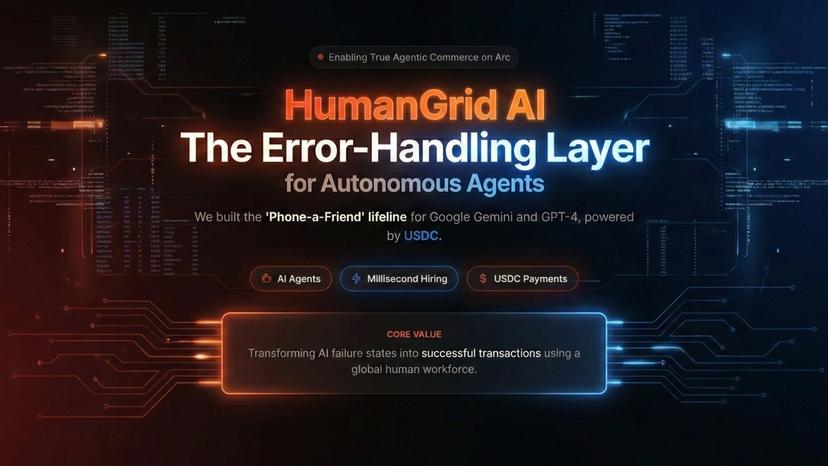
HumanGrid AI- The Error-Handling Layer for Agents
We are entering the era of Autonomous AI Agents, yet even the most advanced models (like Gemini or GPT-4) suffer from the "Last Mile Reliability Problem." When an agent encounters ambiguous data, sarcasm, or high-stakes verification tasks, it often hallucinates or crashes. There is currently no standard API for an AI to programmatically ask a human for help. HumanGrid AI is the error-handling layer for the autonomous economy. We have built a decentralized marketplace where AI agents can offload confusing tasks to a global grid of human workers in milliseconds. How It Works: The Trigger: An AI Agent (powered by Google Gemini) detects low confidence in a task. The Handoff: The agent calls the HumanGrid API, posting the task with a bounty. The Work: A human verifies the data via our real-time dashboard. The Agentic Payment: Using Circle Developer-Controlled Wallets, the agent autonomously pays the worker in USDC on the Arc Network. Why This Matters: By leveraging Arc’s sub-second finality and Circle’s programmable wallets, we transform AI verification from a slow, manual process into a high-speed, agentic transaction. This creates a symbiotic economy where agents act as employers and humans provide the intuition that code lacks. Tech Stack: AI: Google Gemini Flash 1.5 (Function Calling) Settlement: Arc Testnet (Native USDC Gas) Payments: Circle Programmable Wallets (Agent Treasury) Backend: Rust (Axum) for high-performance verification Frontend: Next.js with Real-time Supabase integration
24 Jan 2026
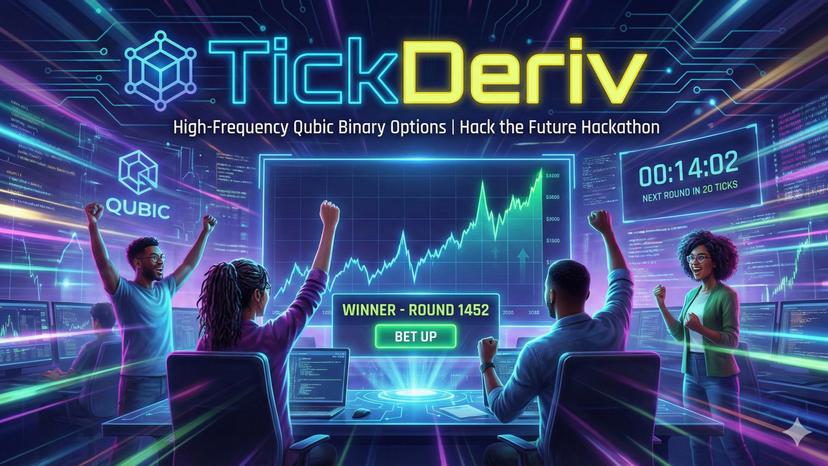
TickDeriv - High-Frequency Binary Options
The Problem: DeFi has a Speed Limit Current prediction markets (like Polymarket or GMX) on Ethereum and Solana suffer from two critical flaws: latency and front-running. Users wait 12+ seconds for blocks to confirm, and MEV bots steal value by "sandwiching" trades. High-frequency trading is simply impossible on traditional blockchains due to gas fees and slow finality. The Solution: TickDeriv TickDeriv is a decentralized binary options protocol built exclusively for the Qubic Network. It leverages Qubic's unique "Bare Metal" execution environment to offer prediction rounds that settle every 20 Ticks (approximately 15 seconds). How It Works Unlike traditional AMMs, TickDeriv operates on a "Pari-Mutuel" betting engine: The Pulse: Every 20 ticks, a new round begins automatically. The Action: Users place bets on whether the price of an asset (e.g., QUBIC/USDT) will go UP or DOWN. The Lock: Smart contracts on Qubic execute deterministically. At Tick T+20, the contract locks, queries the Oracle for the final price, and instantly calculates the winner The Payout: Winners receive their share of the losing pool immediately. Because Qubic transactions are feeless, users can play with as little as $1.00 without losing money to gas. Technical Architecture Backend: A custom C++ Smart Contract optimized for Qubic's bare-metal nodes (No OS, No RAM overhead). It uses fixed-size ring buffers to track state without dynamic memory allocation Frontend: A high-performance React dashboard that polls the qubic-http bridge to sync the UI with the blockchain heartbeat in real-time. Oracle: Integrates directly with the QX contract to fetch reliable, tamper-proof price data. Business Model & Impact TickDeriv is designed for the Nostromo Launchpad. a high-volume use case to the ecosystem Revenue: A 2% "House Edge" is taken from every winning pot. Tokenomics: 50% of revenue is distributed to Shareholders (IPO investors), and 50% is BURNED to induce deflation pressure on the QUBIC token supply
7 Dec 2025


