.png&w=256&q=75)
🤝 Top Collaborators
.png&w=640&q=75)
.png&w=640&q=75)
.png&w=640&q=75)
🤓 Latest Submissions
CrisisCommand
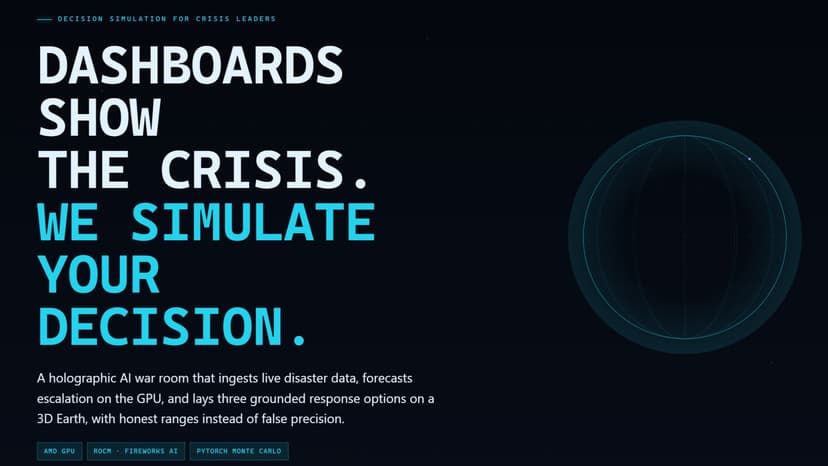
Commercial situational-awareness tools (Crisis24, Dataminr) and public dashboards (GDACS, ReliefWeb) tell a crisis leader WHAT is happening. None simulate what happens next under each response. That decision layer is the hard part, and no open-source equivalent exists. CrisisCommand builds it. Live feeds — USGS earthquakes, GDACS multi-hazard alerts, Indonesia's BMKG seismic network, and rain-driven flood-risk signals computed from official forecasts crossed with documented flood history — stream onto a holographic 3D Earth. GDELT headline density adds low-confidence tension signals. Clicking a crisis opens an AI situation briefing; pressing SIMULATE runs 10,000 stochastic hazard-exposure scenarios as one batched tensor operation, then an LLM reasons over three policy branches: evacuate now, pre-position and act on triggers, or monitor. Each option carries an exposed-population range, cost band, response time, and trade-offs. Selecting one renders the affected zones in 3D. The AMD story is engineered in, not bolted on. The Monte Carlo engine is pure batched PyTorch/ROCm tensor math, no Python loops over runs. The code path is device-agnostic: ROCm presents as cuda, and the UI names whichever Instinct card the backend self-reports — we never hardcode a GPU model. vLLM serves the scenario-reasoning model on the AMD GPU, where batching parallel branches pays off, while Fireworks AI (itself AMD-powered) handles briefings. Deduplication embeds and clusters on-GPU. Honesty is a hard rule, not a feature. Every figure is a p10–p90 range, never false precision. The LLM only does arithmetic on Monte Carlo outputs; it never invents numbers. Live events lacking vetted population data are deliberately NOT simulable: inventing an exposure base is worse than showing nothing. Everything is labelled SIMULATION DECISION SUPPORT ONLY, and a human always chooses: these are options with trade-offs, never "the AI decided." The demo runs offline against 15 curated historical events.
13 Jul 2026
