🤝 Top Collaborators
🤓 Latest Submissions
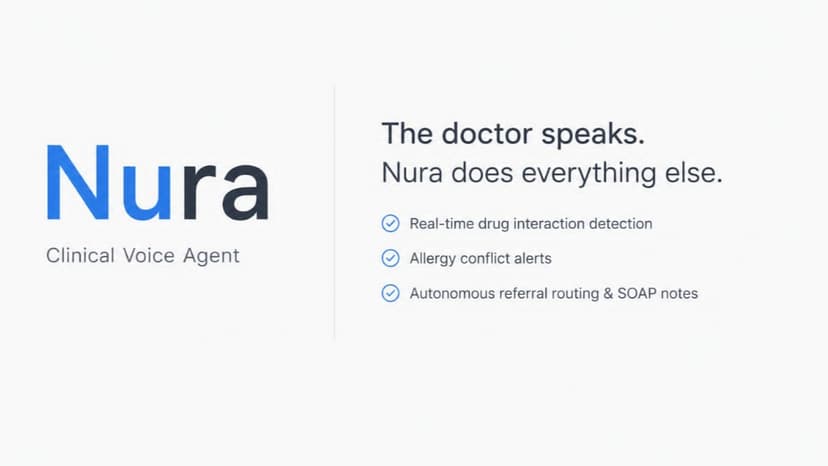
Nura — Autonomous Clinical Voice Agent
Nura is an autonomous clinical voice agent that goes far beyond existing AI scribes. While products like Nuance DAX, Abridge, and Nabla only generate notes, Nura transcribes, reasons, and acts — all without physician input. The Problem: Physicians spend 3+ hours daily on documentation alone. 43% experience burnout, costing US healthcare $4.6 billion annually in turnover. Current AI scribes only solve transcription — they don't detect clinical issues, flag conflicts, or take action. How Nura Works: The doctor presses ONE button. Nura processes real clinical audio through Speechmatics' Medical Model (98% accuracy, real-time speaker diarization), then feeds diarized transcript segments into the LLM for clinical reasoning. The autonomous agent pipeline: • Detects drug interactions by cross-referencing medications against the patient's record • Flags allergy conflicts when a prescribed drug conflicts with documented allergies • Classifies urgency and triggers specialist referrals for critical findings • Updates the patient record with newly detected conditions and symptoms • Generates a complete SOAP note (Subjective, Objective, Assessment, Plan) • Books follow-up appointments by parsing scheduling context from the conversation • Routes reports to the correct department and alerts care teams — all autonomously The demo accepts any clinical audio — upload a real recording or use the built-in samples — and produces live transcription, real-time action cards, and a full autonomous post-analysis workflow including appointment booking and department routing. Enterprise Value: AI documentation tools save an estimated 5.6 minutes per appointment (JAMA, 2024). For a 200-doctor hospital averaging 20 visits/day, that's 373 physician-hours saved weekly. Combined with prevented adverse drug events ($50K–$100K each), the ROI is substantial.
19 May 2026
