
Mohammad Azlaan@azlaanmohammad6624905
7
Events attended
3
Submissions made
Pakistan
1 year of experience
About me
Biomedical Engineering student at Ziauddin University with a focus on AI-driven health tech. Building things at the intersection of machine learning, embedded systems, and clinical applications — from wearable biosignal monitors to multi-agent biomedical research pipelines. Always building, always shipping.
🤓 Latest Submissions
ARIA - Automated Research Intelligence Agent
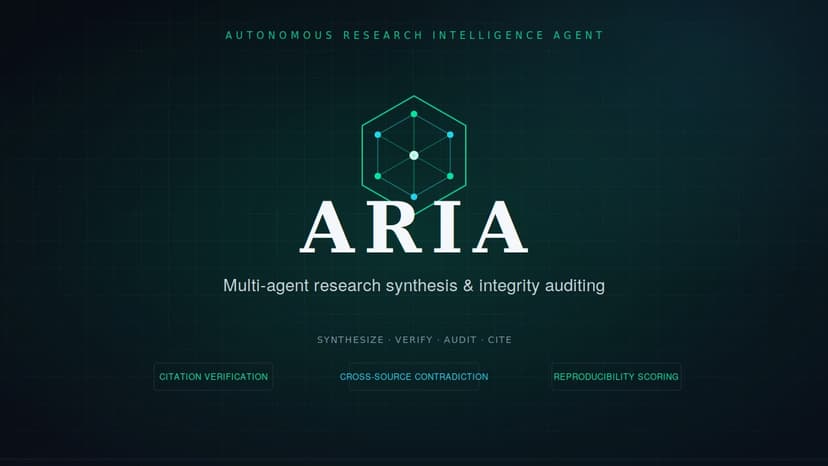
ARIA (Autonomous Research Intelligence Agent) is a multi-agent pipeline that turns a clinical question into a rigorously synthesized, citation-backed answer, then interrogates its own sources for integrity issues most researchers never have time to check by hand. The core pipeline runs five stages: a Query Architect generates MeSH-optimized search strategies, a Literature Scout retrieves matching papers from PubMed and Europe PMC, a PRISMA Filter screens for relevance, an Evidence Synthesizer builds a structured, cited synthesis, and a Citation Builder formats references. The result is a clinical-grade literature review complete with a comparison table, PRISMA exclusion log, and predictive forecasting of where the evidence is heading. What sets ARIA apart is its Integrity Audit layer, five independent detection agents that stress-test the synthesis itself: a Citation Ghost Detector flags citations that don't actually support their attached claims, a Methodology Drift Tracker catches when a paper's results section doesn't match its stated methods, a Confidence Calibration Check flags language stronger or weaker than the underlying data supports, a Cross-Paper Contradiction Finder surfaces where cited studies genuinely conflict rather than just differ in topic, and a Reproducibility Score grades whether a study reports enough detail to be redone. Each runs in parallel against the same papers already retrieved, no extra fetching, and renders as color-coded, explainable flags across two views: internal consistency and external validity. Built on LangGraph for orchestration and Qwen2.5-72B served via vLLM on an AMD MI300X, ARIA treats research synthesis and research auditing as one system, not two separate tools.
13 Jul 2026
VERDICT: Evidence-First Candidate Evaluation
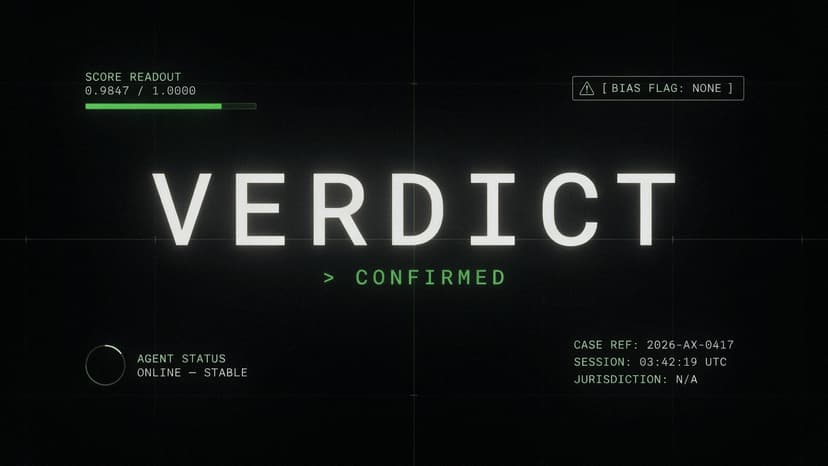
Capable candidates get rejected by broken evaluation systems that reward presentation over substance. No feedback. No transparency. No accountability. Just silence. VERDICT was built to fix that. VERDICT is a multi-agent candidate evaluation system where four specialized AI agents collaborate through Band to assess candidates across research program admissions, corporate hiring, and compliance screening. Each agent processes the candidate profile in sequence and posts its output to a Band room, handing off context to the next agent in the pipeline: - Evidence Extractor parses the candidate profile for verifiable, concrete signals — projects, skills, experience, achievements. - Criteria Mapper scores that evidence against explicit role requirements with per-criterion justification and an overall fit score. - Bias Auditor flags irrelevant evaluation factors — geographic bias, institutional prestige bias, GPA cutoff rigidity, publication gatekeeping. - Accountability Agent produces a mandatory structured verdict (ADVANCE / WAITLIST / REJECT) with full evidence citations, candidate feedback, and an improvement roadmap. The system was validated with a real candidate profile: a Biomedical Engineering undergraduate applying to the MITACS Globalink Research Internship. VERDICT returned a WAITLIST verdict at 80% confidence, caught three bias flags, and produced a 70/100 signal score — all with full reasoning visible in the Band feed. Built on Flask, LangGraph, LangChain, Groq (Llama 3.3 70B), and the Band REST API. This system exists because the current process failed someone who deserved better. VERDICT cannot give back what was lost. But it can make sure the next candidate gets an answer they can actually use.
19 Jun 2026

ARIA - Biomedical Research Intelligence Assistant
ARIA — Autonomous Research Intelligence Agent — is a five-stage multi-agent system designed to eliminate the manual bottleneck in biomedical literature review. Researchers currently spend weeks identifying, screening, and synthesizing published evidence before any meaningful analysis can begin. ARIA compresses that entire workflow into under sixty seconds. Built on Llama 3.3 70B deployed on AMD MI300X hardware, the pipeline operates through five specialized agents: a Query Architect that generates optimized PubMed search strings from natural language input, a Literature Scout that fetches papers from PubMed and Europe PMC simultaneously, a PRISMA Filter that screens each paper against clinical relevance criteria, an Evidence Synthesizer that constructs a structured report with graded evidence levels and research gap analysis, and a Citation Builder that formats all references to standard. Beyond synthesis, ARIA offers a Predictive Model generating constructive and destructive research forecasts, a methodology comparison table, a follow-up question interface grounded exclusively in the retrieved dataset, and one-click PDF export of the complete review. The business case is direct: pharmaceutical teams, clinical trial designers, and academic institutions spend significant resources on systematic reviews that ARIA automates at scale. The system is hardware-optimized for AMD MI300X infrastructure, making it a viable enterprise deployment on existing clusters. ARIA does not summarize the internet — it synthesizes verified, source-linked, peer-reviewed evidence. That distinction is what makes it production-relevant for regulated research environments.
10 May 2026


