
🤓 Latest Submissions
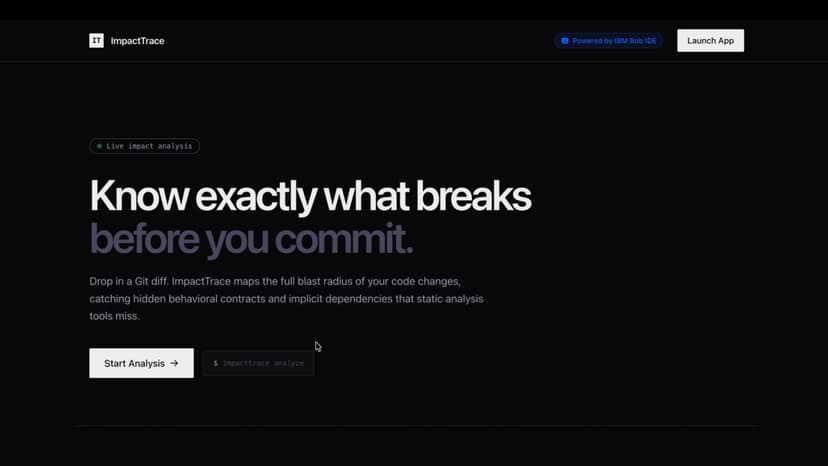
ImpactTrace: Pre-Commit AI Change Intelligence
**The Problem**: Modern microservices and monorepos are incredibly complex. When a developer makes a change, traditional static analysis tools (like linters and AST parsers) can only warn them if they break a direct import statement. However, production outages are rarely caused by broken physical imports—they are caused by broken implicit dependencies, such as assumed event payloads, shared database states, and undocumented behavioral contracts. **Our Solution**: ImpactTrace solves this by predicting the true "blast radius" of any code change before it is ever committed. We transform AI from a simple code-completion tool into a robust structural safety net for enterprise engineering teams. **How it Works (The Architecture)**: To achieve this, we integrated IBM Bob IDE as the intelligence layer. Rather than just looking at a Git diff in isolation, Bob IDE reads the entire repository to understand the underlying architecture and the developer's specific intent. This massive context payload is then fed into our Node.js backend. The backend constructs an advanced reasoning prompt and queries the powerful NVIDIA Nemotron model (via OpenRouter). Nemotron analyzes the code against the full repository context to uncover hidden transitive callers and implicit behavioral contracts that a standard AST parser could never see. **The User Experience**: Instead of making developers stare at a loading spinner while waiting for a massive LLM generation, our backend streams Nemotron's reasoning back to the frontend in real-time using Server-Sent Events (SSE). Our custom React Flow interface progressively builds an interactive, industrial-grade dependency map as the stream arrives. It highlights exactly which downstream services will fail, categorizes the risk level (Low, Medium, High), and provides actionable remediation steps generated directly from the AI's analysis.
17 May 2026
