Arjun Taware@arjuntaware484
1
Events attended
1
Submissions made
India
3+ years of experience
About me
As Chief Technology Officer of Refyn Technologies Arjun Taware leads the development of an innovative network level AI plugin to protect academic integrity. Alongside co founders Rohin Wadhwa and Avyaay Rathi he built a proactive filter that integrates into school internet networks to manage student interactions with AI in real time. By blocking prompts that generate direct answers the technology transforms AI into an ethical tutor that encourages critical thinking. The venture earned strong backing from incubators like Lemon Ideas and was showcased at the Viksit Bharat Startup Conclave.Beyond this startup Arjun is a standout student at Indus International School Pune where he serves as President of the Ctrl Alt Explore Computer Science Club. He leads the AI and Data Science branch by conducting coding workshops and mentoring student projects in machine learning. Additionally he works as an AI Data Analytics Intern at the InAmigos Foundation optimizing research workflows and data reporting.His elite STEM achievements further highlight his technical talent on a global stage. Arjun secured an All India Rank 10 and a global Gold Medal in the American Mathematics Olympiad placing in the top 8 percent worldwide. He also earned an All India Rank 8 and Global Rank 16 in the iCode Global Hackathon Python Advanced division alongside a Top 100 finish in the Harvard Undergraduate Science Olympiad.
🤝 Top Collaborators
.png&w=640&q=75)
.png&w=640&q=75)
🤓 Latest Submissions
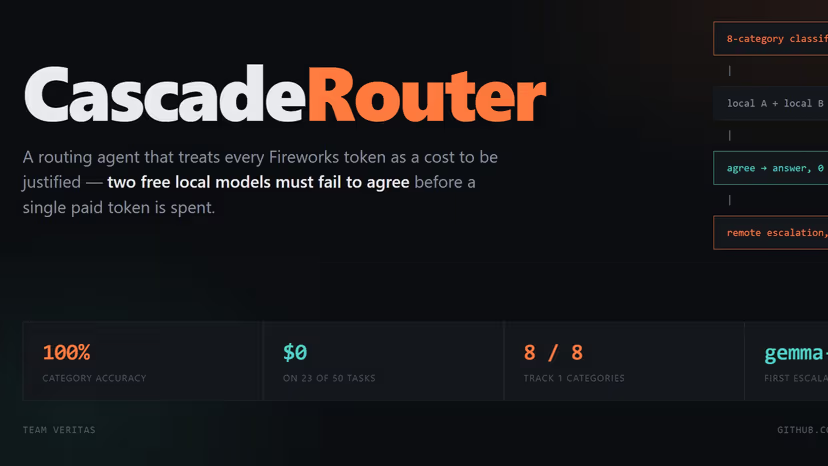
CascadeRouter — Token-Efficient Routing Agent
CascadeRouter is a Track 1 agent built on one principle: the cheapest token is the one you never send. Every task is first classified into one of the eight competition categories, then routed down the cheapest path that still clears the accuracy gate. Factual and sentiment tasks go to two bundled 1B-class local models (Llama 3.2 1B and Qwen2.5 1.5B, different training lineages) that answer independently. If they agree, that's the answer at zero Fireworks tokens — agreement between unrelated models is a stronger free confidence signal than any single model's self-rating. Math and logic tasks go straight to remote self-consistency: up to 4 reasoning votes through the cheapest allowed Fireworks model, early-stopped as soon as two agree, cutting 37% of tokens at unchanged accuracy. Small local models fail arithmetic in correlated ways, so local agreement is skipped here. Code generation, debugging, summarization, and NER go to a single remote call with a category-tuned prompt. NER lives here because it's graded on completeness, which a local critic can't verify — a 1B model once dropped an entity that its own critic confidently approved. Escalation is verify-not-regenerate: the remote model is sent the local draft and asked to confirm or fix it, not re-answer from scratch — far cheaper than regeneration. ALLOWED_MODELS is read at runtime and auto-ordered Gemma-first, largest-first, so every escalation lands on Gemma 4 31B IT via Fireworks. Every tier emits structured JSON, no filler tokens. The escalation threshold is calibrated against our own decision logs. The submission is a single self-contained linux/amd64 image: agent, Ollama, and both local models baked in. It reads /input/tasks.json, writes /output/results.json, honors all env vars, runs on a worker pool with 25s timeouts, and degrades gracefully on failure. Validation on real models: 8/8 across all eight categories at 2,597 remote tokens, and 100% accuracy at 16,730 tokens with 23 of 50 tasks free.
13 Jul 2026
