
🤓 Latest Submissions
Incident Brain: Autonomous AI for Handling Outages
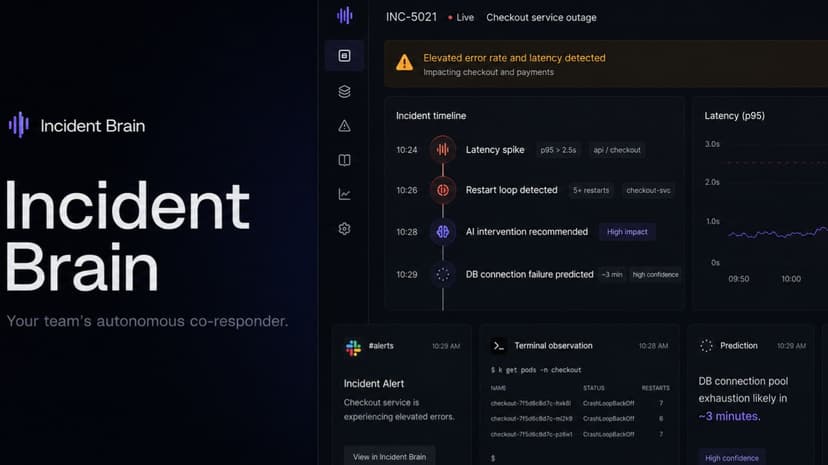
Incident Brain is an autonomous co-responder for production incidents built with Google Gemini and Veea Lobster Trap. It continuously ingests Slack conversations and terminal or screen activity during live outages, converts them into structured events, and builds a searchable semantic timeline in real time. Instead of acting like a chatbot that waits for prompts, Incident Brain proactively monitors the flow of an incident. Every action, hypothesis, observation, failure, and mitigation attempt is embedded into long-term incident memory using pgvector similarity search. When engineers repeat actions that previously failed in similar incidents, the system immediately warns the team with contextual reasoning grounded in historical outcomes. Google Gemini powers multimodal event extraction, reasoning, embeddings, intervention generation, cascade prediction, and automated post-mortem creation. Veea Lobster Trap provides a governed AI gateway layer for secure and policy-aware model traffic during incident analysis. Incident Brain also predicts cascading failures before they happen. By analyzing the evolving incident narrative, it identifies likely downstream failures, estimates confidence, and recommends mitigation steps while the outage is still unfolding. If the system detects that responders are stuck in a failure loop, it escalates into an autonomous co-responder. It synthesizes the current timeline, warning history, and historical recovery patterns to suggest actionable next steps directly in Slack and the live dashboard. Privacy is built into the architecture. Sensitive terminal data is redacted locally using OCR and Presidio before any structured events are sent to Gemini. Raw screenshots and secrets stay on the engineer’s machine. After resolution, Incident Brain automatically generates a complete post-mortem with timelines, root cause hypotheses, failed attempts, successful mitigations, and follow-up actions.
19 May 2026
Incident Brain - Your autonomous co-responder
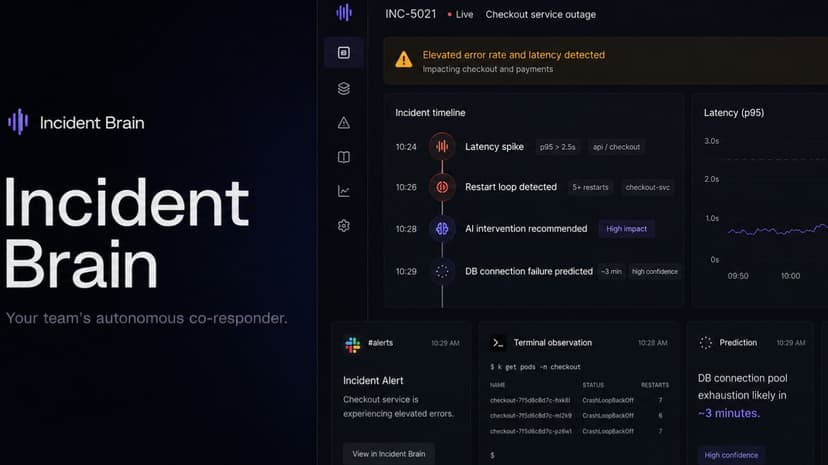
Incident Brain is an autonomous co-responder for production incidents built with Google Gemini. It continuously ingests Slack conversations and terminal or screen activity during live outages, converts them into structured events, and builds a searchable semantic timeline in real time. Instead of acting like a chatbot that waits for prompts, Incident Brain proactively monitors the flow of an incident. Gemini powers event extraction, multimodal reasoning, embeddings, prediction, intervention synthesis, and post-mortem generation across the entire pipeline. Every action, hypothesis, observation, failure, and mitigation attempt is embedded into long-term incident memory using pgvector similarity search. When engineers repeat actions that previously failed in similar incidents, the system immediately warns the team with contextual reasoning grounded in historical outcomes. Incident Brain also predicts cascading failures before they happen. By analyzing the evolving incident narrative with Gemini, it can identify likely downstream failures, estimate confidence, and recommend mitigation steps while the outage is still unfolding. If the system detects that responders are stuck in a failure loop, it escalates into an autonomous co-responder. It synthesizes the current timeline, warning history, and historical recovery patterns to suggest actionable next steps directly in Slack and the live dashboard. Privacy is built into the architecture. Sensitive terminal data is redacted locally using OCR and Presidio before any structured events are sent to Gemini. Raw screenshots and secrets stay on the engineer’s machine. After resolution, Incident Brain automatically generates a complete post-mortem with timelines, root cause hypotheses, failed attempts, successful mitigations, and follow-up actions. Built with FastAPI, React, Supabase, pgvector, Slack Bolt, and Google Gemini, Incident Brain turns incident response into a continuously learning operational memory system.
19 May 2026


