Walid Tidjani@aren614
aren614
🤓 Latest Submissions
RoboGripAI
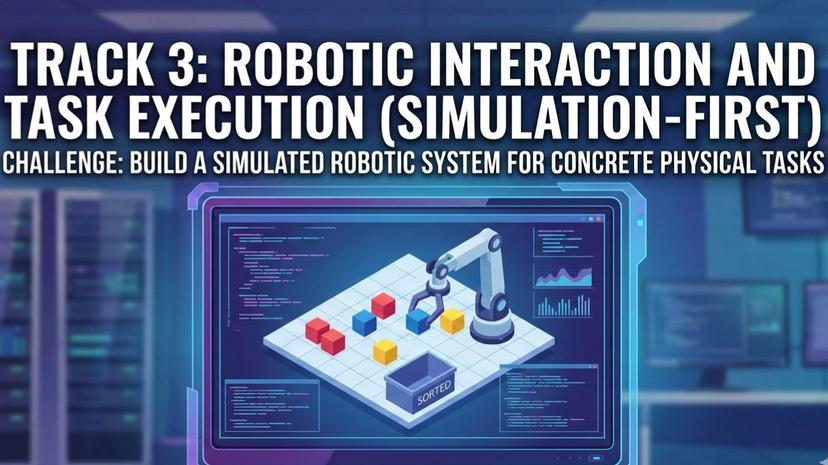
This project presents a simulation-first robotic system designed to perform structured physical tasks through reliable interaction with objects and its environment. The system focuses on practical task execution rather than complex physics modeling, ensuring repeatability, robustness, and measurable performance across varied simulated conditions. Simulation-first robotic system performing structured physical tasks such as pick-and-place, sorting, and simple assembly. Designed for repeatable execution under varied conditions, with basic failure handling, environmental interaction, and measurable performance metrics. A key emphasis of the system is reliability under dynamic conditions. The simulation introduces variations such as object position changes, minor environmental disturbances, and task sequence modifications. The robot is designed to adapt to these variations while maintaining consistent task success rates. Basic failure handling mechanisms are implemented, including reattempt strategies for failed grasps, collision avoidance corrections, and task state recovery protocols. The framework incorporates structured task sequencing and state-based control logic to ensure deterministic and repeatable behavior. Performance is evaluated using clear metrics such as task completion rate, execution time, grasp accuracy, recovery success rate, and system stability across multiple trials. The modular system design allows scalability for additional tasks or integration with advanced planning algorithms. By prioritizing repeatability, robustness, and measurable outcomes, this solution demonstrates practical robotic task automation in a controlled simulated environment, aligning with real-world industrial and research use cases. Overall, the project showcases a dependable robotic manipulation framework that bridges perception, decision-making, and action in a simulation-first setting, delivering consistent and benchmark-driven task execution.
15 Feb 2026


