.png&w=256&q=75)
🤓 Latest Submissions
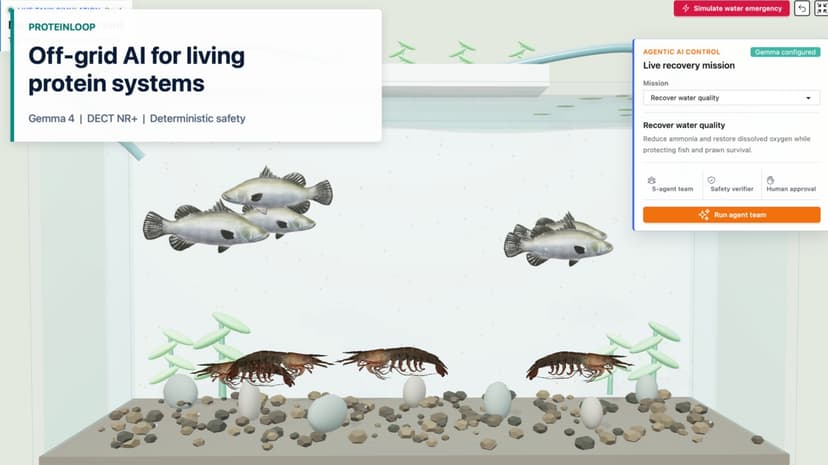
ProteinLoop: Off-Grid Agentic Aquaponics
ProteinLoop closes a food-security gap in aquaponics, which is often presented mainly as vegetable production. It coordinates fish, freshwater prawns, plants, duckweed feed, chickens, and eggs as one measurable food loop. Operators see a live tank where ammonia is waste in water and dissolved oxygen is the air animals breathe. In emergencies, chemistry, animal behavior, and protein at risk change together. Four Gemma agents analyze fish, prawns, plant filtration, and feed; a supervisor combines their structured recommendations into a bounded recovery plan. Gemma may propose aeration, feeding, water exchange, or harvest, but cannot mutate the ecosystem. A deterministic Python verifier checks each action first. Unsafe proposals become structured feedback; risky or irreversible actions require producer approval. The demo shows collapse versus recovery, reward evidence, decision receipts, and two-node Elixir Horde recovery. Two physical Nordic nRF9151 boards prove a bidirectional DECT NR+ link between tank and gateway without farm Wi-Fi, a SIM, or cloud transport. An edge computer runs self-hosted Gemma 4 E2B with llama.cpp, Phoenix LiveView, and the same verifier. For AMD Act II, google/gemma-4-E2B-it ran through vLLM on ROCm on the assigned AMD notebook with a 47.98 GiB gfx1100 GPU. In a reproducible 20-emergency audit, only 2 first answers were safe. Exact verifier feedback repaired the other 18, producing 20/20 model-safe plans with zero fallback. A five-emergency audit protected 103.1 kg of aquatic biomass. This is verifier-guided inference-time repair, not training or a weight update. ProteinLoop demonstrates local and AMD-hosted inference, multi-agent coordination, deterministic safety, Docker deployment, producer control, and physical radio transport. Chemistry probes, measured solar autonomy, field range, and regional spectrum validation are the next rural-deployment milestones.
13 Jul 2026
