.png&w=256&q=75)
🤓 Latest Submissions
Cyrus: Autonomous Space Weather Defense System
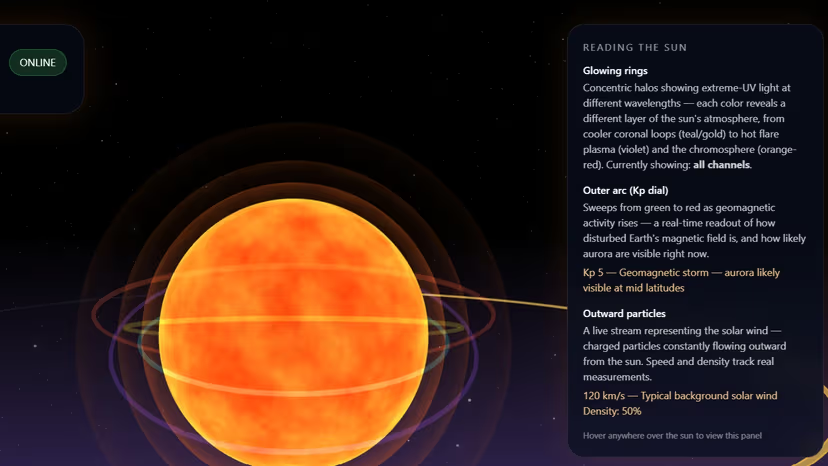
Space weather can disrupt satellites, aviation, power grids, navigation, and radio communications. Solar flares can cause HF radio blackouts within minutes, while coronal mass ejections and high speed solar wind streams can trigger geomagnetic storms that threaten critical infrastructure. Cyrus transforms space weather forecasting from passive monitoring into coordinated operational response. At its core is a Surya inference service optimized to run on AMD GPUs with ROCm. Rather than only running the foundation model, we configured Surya to execute all four downstream tasks within a unified service: solar flare forecasting, active region segmentation, EUV spectral prediction, and solar wind forecasting. Using NASA Solar Dynamics Observatory observations, the service performs accelerated inference, combines the outputs into a complete solar threat picture, and publishes forecasts through RabbitMQ for autonomous processing. LangGraph agents powered by Fireworks AI consume these forecasts and connect to the Cyrus Command Center registry of satellites, flights, and power grid assets. Using operational tools, agents identify affected infrastructure and execute protective actions. Satellites can be placed into safe mode, vulnerable assets can be prioritized, aviation routes can be adjusted around communication risks, and grid operators can receive mitigation actions during geomagnetic storms. A Commander agent synthesizes all decisions into a single operational briefing. Redis Streams provide real time communication between the intelligence layer and the 3D command dashboard. Operators can monitor solar activity, active regions, flare probability, EUV conditions, solar wind forecasts, affected assets, and agent actions as events evolve. By combining AMD accelerated AI inference, scientific foundation models, event driven architecture, and autonomous agents, Cyrus turns complex space weather data into actionable intelligence for protecting critical infrastructure.
13 Jul 2026


