
.png&w=256&q=75)
🤝 Top Collaborators
.png&w=640&q=75)
.png&w=640&q=75)

🤓 Latest Submissions
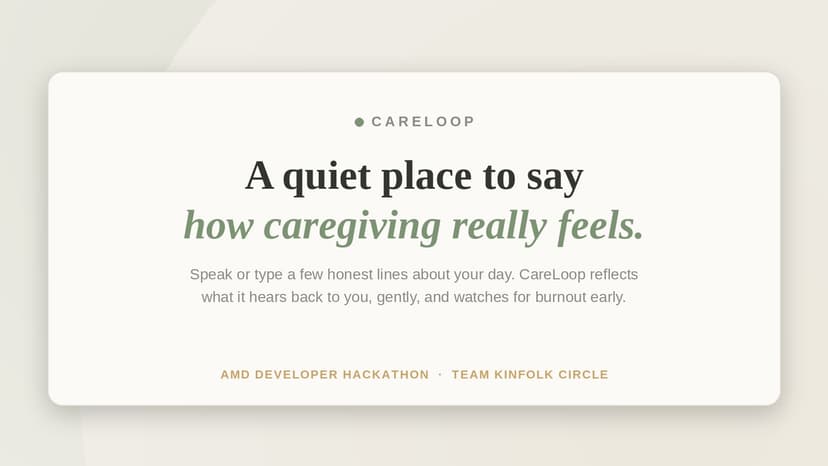
CareLoop - Catching Caregiver Burnout Early
Family caregivers looking after aging parents or sick relatives often don't notice their own burnout until it's already a crisis. There's rarely time to reflect, and by the time exhaustion becomes visible to others, the caregiver has usually been struggling alone for a while. CareLoop was built to catch that decline earlier, fitting into a caregiver's day instead of adding another task to it. The idea is simple: a caregiver writes or speaks a short journal entry about their day, the way they'd say it out loud to a friend. CareLoop reads that entry and reflects back what it notices across five areas that tend to surface first in burnout: sleep loss, isolation, resentment, physical strain, and emotional exhaustion. Each entry is scored gently, not clinically, and saved so the caregiver sees a trend over time rather than one isolated bad day. When strain builds, CareLoop surfaces relevant support, like local respite care, caregiver support groups, or counseling, matched to whatever's showing up most. Under the hood, a FastAPI backend scores each entry using an AI model (Gemini, or Fireworks hosting Gemma), with a free rule-based fallback so the app still works without an API key. Entries are stored simply in a local JSON file, so the data pipeline stays transparent. The frontend is a single, custom-designed interface built to feel calm and human rather than clinical, with a signature trend line that reads more like a gentle pulse than a corporate dashboard. Voice input is supported too, so caregivers can speak an entry instead of typing when they're too tired to write. The whole app is containerized with Docker, backend and frontend as separate services tied together with Docker Compose, ready to run on AMD Developer Cloud infrastructure.
13 Jul 2026


