
Ahmad Ali Arshad@ahmadaliarshad497
3
Events attended
3
Submissions made
1 year of experience
About me
Full Stack Engineer with expertise in building scalable web applications, backend services, and database-driven solutions. Skilled in Python, C/C++, JavaScript, React, Node.js, SQL, and DBMS with hands-on experience in AI-powered applications, generative AI, and modern web development. Passionate about solving complex problems, optimizing performance, and contributing to innovative projects. Technical Skills:- Frontend: HTML5, CSS3, JavaScript, React.js Backend: Node.js, Express.js, Python (Flask/Django) Databases: MySQL, SQL, Database Management Systems (DBMS) Programming: C/C++, Python, JavaScript Version Control & Tools: Git, GitHub Other Expertise: Artificial Intelligence, Generative AI, REST APIs, Digital Marketing, Project Management, Research & Analysis Projects:- 1. AI-Powered Web Application - Developed a web-based platform integrating Generative AI models for text and data processing. - Implemented frontend using React.js and backend APIs with Node.js + Express. - Managed data storage and queries using MySQL. 2. Portfolio & Blog Website - Designed and deployed a personal portfolio with HTML5, CSS3, and JavaScript. - Integrated content management with database-driven architecture. - Used Git & GitHub for version control. 3. Database Management System (Mini Project) - Built a student records management system with SQL + Python. - Implemented CRUD operations and optimized queries for efficiency.
🤝 Top Collaborators


.png&w=640&q=75)
🤓 Latest Submissions
BrainOS — Enterprise Knowledge Execution Platform
Every company runs on knowledge scattered across policies, SOPs, and the heads of whoever's been there long enough to remember the exceptions. AI agents don't have that instinct. Most "enterprise AI" tools just search documents and hand back a paragraph — which isn't enough for an agent to safely act on its own. BrainOS reads uploaded company documents and builds a structured company brain: entities, rules, and reusable Skill Cards — an auditable, executable definition of a business process, with its inputs, conditions, and action. Ask BrainOS a real question, and it retrieves the matching skill, checks each condition against the situation, and returns an answer with a full step-by-step reasoning trace, not a black-box response. The pipeline runs document upload, text extraction, LLM-based entity and skill extraction, vector storage in Qdrant, and agent reasoning, all through a provider-agnostic API layer. During development we used the Google AI Studio (Gemini) API; for judging, the same code path points at Fireworks AI, which serves inference on AMD Instinct GPUs, via a one-line environment swap. The working prototype: upload a policy document, watch entities and skills extract in real time on the dashboard, inspect the generated Skill Card, then ask a live question and watch the reasoning trace resolve. Not a search tool wrapped in a chat window — the structured knowledge layer AI agents need to act safely inside a real company.
13 Jul 2026
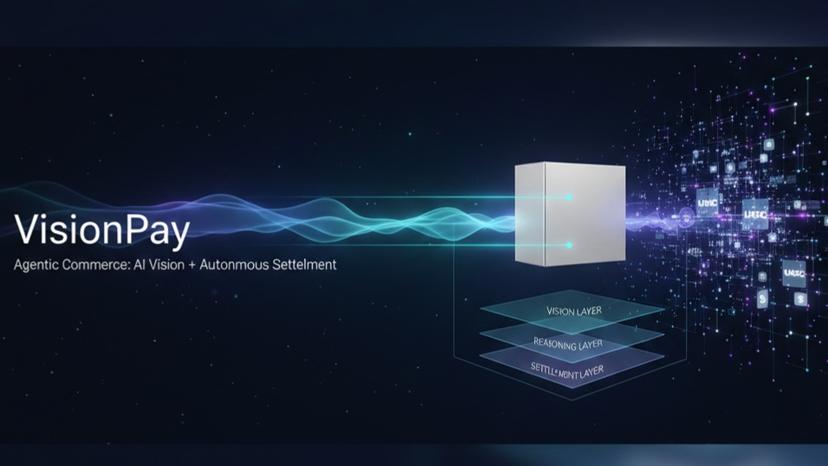
VisionPay
VisionPay is a next-generation Agentic Commerce system built on the Arc Layer-1 blockchain, showcasing the future of the Machine-to-Machine (M2M) economy. It enables AI agents to autonomously understand user intent, reason over purchasing decisions, and execute payments using USDC—without manual intervention. The Problem: Modern commerce is fragmented and manual. AI systems can recognize products, and blockchains can process payments, but there is no unified system that allows an AI agent to autonomously connect visual understanding with onchain transactions. The Solution: VisionPay bridges this gap by combining Google Gemini 1.5 multimodal vision with Arc’s EVM-compatible settlement layer, enabling end-to-end autonomous purchasing driven by visual input. How It Works (Agentic Flow)? • Multimodal Perception: Users upload an image of a product (live camera or gallery). Gemini 1.5 Flash analyzes the image to identify the product, brand, and context. • Autonomous Reasoning: Using a LangGraph-based agent, the system acts as an independent broker—searching for comparable products and selecting the best available price. • USDC-Native Settlement: Once a decision is made, the agent constructs and signs a transaction via Web3, executing payment directly on the Arc Testnet using USDC as native gas, ensuring stable and deterministic settlement. Why Arc & Circle? Arc’s native USDC architecture removes volatility and currency-swap friction, allowing AI agents to hold and spend a stable, programmable currency. Circle’s USDC enables secure, transparent, and trust-minimized autonomous transactions for goods, APIs, and services. Key Technologies: AI: Google Gemini 1.5 (Multimodal Vision & Reasoning) Blockchain: Arc Layer-1 (Testnet) Currency: USDC (Native Settlement) Backend: FastAPI, LangGraph, Web3.py
24 Jan 2026


