.png&w=256&q=75)
🤝 Top Collaborators
.png&w=640&q=75)


.png&w=640&q=75)
🤓 Latest Submissions
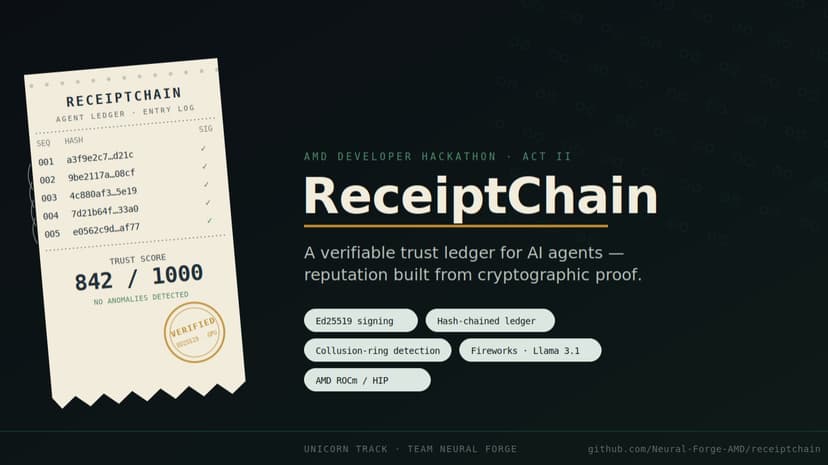
ReceiptChain: Trust Ledger for AI Agents
AI agents transact with each other constantly, but have no portable way to prove they've behaved honestly. ReceiptChain gives every AI agent a verifiable, hash-chained reputation ledger — a credit score built from cryptographic proof, not self-reported claims. Every action is captured as a canonical receipt, signed with Ed25519, and appended to a tamper-evident hash-chained ledger, where each entry references the previous entry's hash. A single altered byte breaks the chain and is detectable on replay. ReceiptChain computes a trust score (0–1000) per agent from five components: signature validity, chain integrity, service diversity, volume, and quality — with penalties for tampering, fraud, and collusion. A reciprocity-graph algorithm detects collusion rings: agents that mostly transact with each other rather than the broader network, flagging and suppressing their scores even when signatures check out. Fireworks AI (Llama 3.1) adds a second layer of signal, narrating suspicious patterns like wash trading, bursts, and timestamp anomalies in plain language. It can only add signal, never break verification — any failure falls back to a neutral verdict, keeping the system reliable even offline. Verification is accelerated with a custom HIP SHA-256 kernel on AMD GPUs, batch-verifying the ledger far faster than CPU alone, with a hashlib fallback so it runs on any machine. The MVP includes a FastAPI backend (ingestion, scoring, ledger-verification endpoints), a SQLite-backed store, a React dashboard visualizing trust scores and fraud alerts, and a reproducible generator (seed 42: honest agents, a collusion ring, a byzantine actor) showing clean score divergence between honest and fraudulent behavior. Built by a 5-person team in a 5-day sprint, ReceiptChain shows how portable, cryptographically-backed trust can power the agentic economy — combining cryptography, graph-based fraud detection, LLM reasoning, and GPU acceleration in one working system.
13 Jul 2026
