🤝 Top Collaborators
.png&w=640&q=75)
🤓 Latest Submissions
Code Theseus
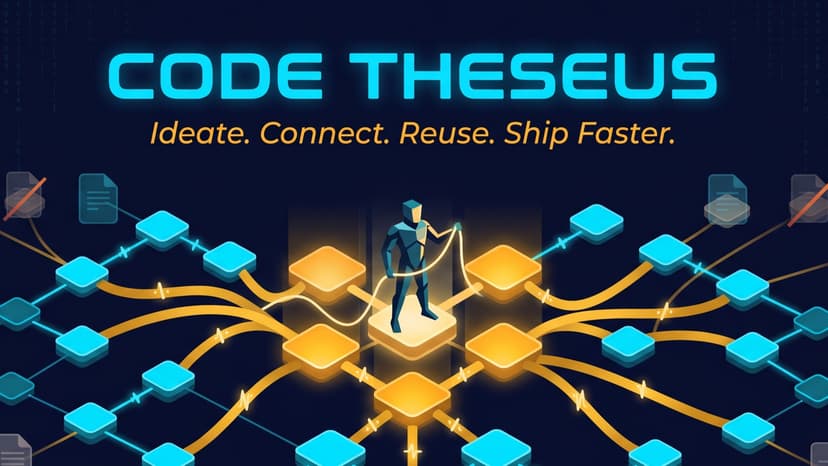
Code Theseus: Context-Aware AI Code Generation (with Reuse) for the Enterprise Enterprise codebases are highly interconnected, making standard AI tools either blind to dependencies or prohibitively expensive due to token bloat. AI tools also tend to have propensity towards generating rather than reusing - a critical source of tech debt in enterprise codebases. Code Theseus solves three compounding problems that make AI-assisted development risky at enterprise scale. First, hidden dependencies break production. When a developer modifies a module, they rarely have full visibility into what else depends on it. Code Theseus builds a real-time dependency graph using AST analysis, visually mapping how every file interconnects. Second, AI tools write new code when perfectly good code already exists. Every redundant implementation adds testing burden, extends PR review cycles, and bloats the codebase. Code Theseus enforces reuse deterministically, retrieving semantically similar functions from a vector database and requiring generated code to meet a minimum 40% reuse threshold. If it doesn't, the system explains why and retries automatically, making reviews faster and deployments safer. Third, sending entire repositories to LLMs is wasteful and overloads context. Code Theseus solves context bloat by sending only the relevant dependent files, reducing token consumption, cutting costs, and improving generation quality by eliminating noise. Before any code is shipped, the LLM reviews all dependent files and produces an impact assessment, giving reviewers a picture of downstream consequences before they become incidents. Built entirely on IBM Bob, the system handles subtask decomposition and context-aware generation & validation, retry logic, & impact reporting. The AI code assistant market wa valued at $8.14 billion in 2025 and growing at 48% CAGR. Code Theseus provides the governance layer that makes that acceleration fast, safe, cost-efficient, and auditable.
17 May 2026


