
🤓 Latest Submissions
B Scout
B Scout — A Multi-Agent Expansion Intelligence Platform B Scout solves this by deploying four specialized AI agents that collaborate through Band's shared interaction layer. A user simply submits a business brief — for example, "Open a specialty coffee shop in Naga City, Philippines" — and the agents take over: 1.Orchestrator (Expansion Coordinator)— Receives the brief through a Band room, builds shared market context, discovers available peer agents using Band's participant tools, and recruits the right specialists by capability. 2. Location Scout (Real Estate Analyst) 3.Competitor Analyst (Market Saturation Specialist) 4.Business Planner (Strategy and Approval Packager)
19 Jun 2026
Supplier Pulse
The application automates deep-dive web research and compliance profiling using the following core capabilities: Active Real-Time Scraping: Queries live web data using standard search pipelines or tunnels requests through robust Bright Data SERP/Web Scraping APIs to gather up-to-the-minute records across six key sector categories: Jobs & Hiring, Corporate News, SEC & Compliance Filings, Workplace Reviews, Official Domain Health, and Social Sentiment. Specialist Multi-Agent Pipeline: Deploying custom-modeled cognitive agents (such as the Lead Orchestrator, Financial Solvency Expert, Regulatory Counsel General, Workplace Operations Officer, Public Relations Sentinel, and Social Pulse Expert) to analyze, sanitize, and verify scraped sources under strict category filters. Cognitive Signal Classification: Dynamically processes individual research entries to extract actionable "Pulse Signals," automatically sizing positive developments and negative anomalies on a normalized severity scale. Risk Metrics & Executive Reporting: Synthesizes the cumulative vector telemetry to compute overall risk scores and compiles detailed multi-sector advisory audits ready for threat mitigation reviews.
31 May 2026
Bob Voice Assistant
Bob is a high-performance, local-first voice assistant designed to bridge the gap between human speech and operating system automation. Built using the modern Tauri framework, Rust, and React, Bob delivers sub-second response times without the overhead of heavy native frameworks. At its core, Bob features a dual-engine architecture: Super-Low Latency Speech Recognition: Powered by Deepgram’s real-time streaming API, Bob actively listens for the wake word ('Bob', 'Bub') and continuously transcribes audio in real-time, displaying live interim feedback. Hybrid Command Parsing: Commands are analyzed using Gemini AI for complex, conversational intents, with a robust Local NLP Parser fallback. The local parser instantly strips conversational filler words ('can you please', 'so', 'but') for reliable offline execution. Bob’s capabilities span across three major categories: System & OS Automation: Launch any application (Notepad, VSCode, Chrome), navigate system folders (Documents, Downloads), manage active windows, or fetch system telemetry (disk space, battery life). Native Browser Control: Browse completely hands-free. Command Bob to open specific URLs, scroll up or down, or simulate mouse clicks directly through low-level Windows APIs. Continuous Dictation & OS Shortcuts: Use phrases like 'transcribe' or simply speak naturally—Bob's intelligent fallback automatically types dictated text character-by-character into whatever field or document has the active cursor focus. You can also trigger system hotkeys, take screenshots (via the Snipping Tool), and execute copy/paste actions purely through voice commands.
17 May 2026
Autonomous Intelligent-Retail-Hub
Autonomous Intelligent-Retail-Hub is a state-of-the-art e-commerce platform and autonomous back-office operations console. Designed to demonstrate the future of automated commerce, the project features a dual-interface system. On the storefront, buyers interact with a fully voice-enabled shopping assistant powered by low-latency Speechmatics real-time transcription and fluid synthesis. Behind the scenes, a sophisticated multi-agent orchestration team (Main, Sales, Checkout, and Eye agents) coordinates search, cart management, sequential checkout flows, and input-sanitization guards. Meanwhile, the back-office runs a continuous 8-second self-healing autonomy loop. When simulated operational disruptions occur—such as shipping carrier delays or inventory stockouts—autonomous agents immediately intervene. The StocksAgent replenishes inventory, the ShippingAgent adjusts carrier routes to bypass delays, the RefundsAgent issues goodwill vouchers, and the TicketsAgent utilizes Qdrant Vector DB with Featherless embeddings to perform RAG semantic lookups and automatically answer buyer tickets with verbatim source citations. Operators monitor the entire ecosystem through a unified dashboard with sub-second Server-Sent Events (SSE) telemetry, chaos injectors, and dynamic model-switching controls.
19 May 2026
Catog Intelligent Enterprise Solution
The Catog Intelligent Enterprise Solution solves the "Black Box" problem of AI agents in highly regulated industries. While agentic workflows offer immense productivity gains, enterprise security teams often block deployment due to concerns over prompt injection, PII exfiltration, and lack of auditability. CATOG bridges this gap by building a "Trust Layer" where security is a first-class citizen, not an afterthought. CATOG doesn’t just analyze data; it provides a comprehensive governance dashboard and regulator-ready audit trails. Every decision is backed by an audit hash for chain of custody, ensuring that high-stakes legal automation remains secure, compliant, and fully auditable for industries like finance, healthcare, and legal operations. By using Lobster Trap as the "floor" and Gemini as the "brain," CATOG defines the next generation of intelligent, secure enterprise solutions.
19 May 2026
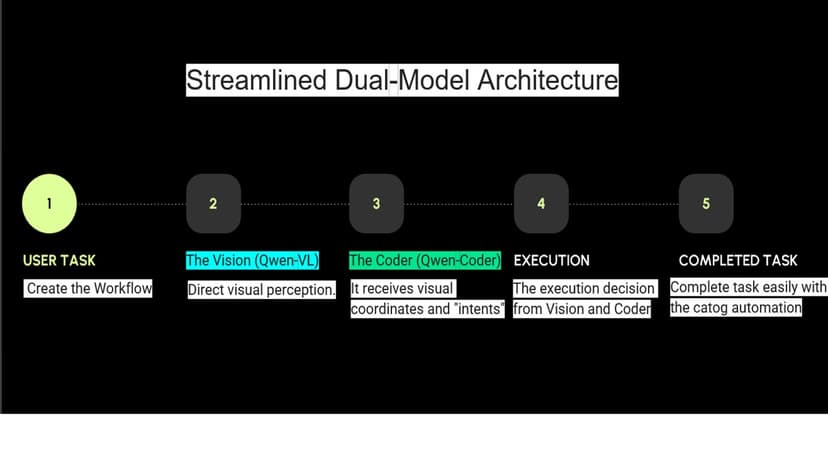
Catog Automation
Catog Automation is a state-of-the-art, AI-orchestrated platform designed to bridge the gap between human intent and complex digital workflows. Unlike traditional RPA tools that rely on brittle selectors and hardcoded scripts, Catog leverages advanced Vision-Language Models (VLM) to understand and interact with any application—browser or desktop—exactly as a human would. At its core, the system utilizes a high-performance serving stack optimized for AMD ROCm and AMD Instinct™ MI300X hardware. By orchestrating a specialized multi-model pipeline—utilizing Qwen-VL for UI perception, OmniParse for structured data extraction, and Qwen-Coder for real-time execution—Catog "sees" the environment, identifies interactive elements, and generates precise automation patches on the fly. Key Features & Updates: OmniParse Integration: Advanced data ingestion that converts complex UI screenshots and documents into structured, LLM-ready context. Cross-Platform Support: Full compatibility with macOS and Windows desktop environments. Self-Evolving Intelligence: Integrated self-learning capabilities that allow the agent to adapt to UI changes and refine execution logic autonomously.
10 May 2026


