.png&w=256&q=75)
🤝 Top Collaborators
.png&w=640&q=75)
🤓 Latest Submissions
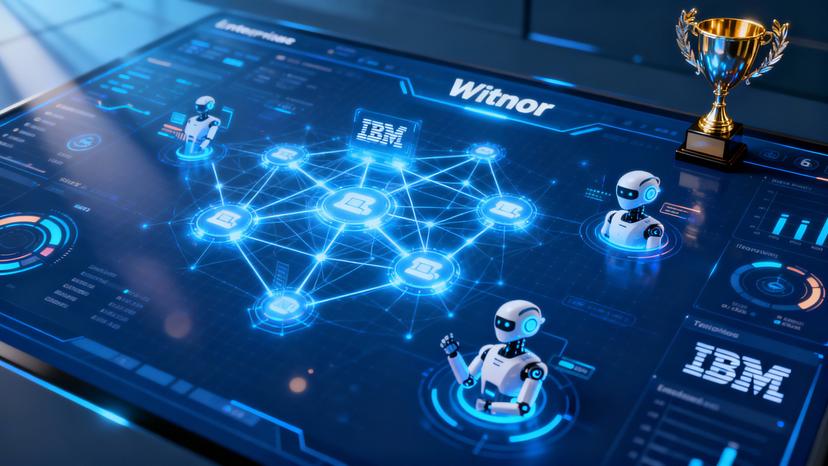
Orchestrix Sentinel - Enterprise AI Governance
Orchestrix Sentinel is my vision of what trusted enterprise AI should look like: open, transparent, auditable, and always production-ready. Our core innovation is a 5-agent governance mesh—every workflow is independently analyzed by specialized agents (Planner, Compliance, Security, Safety, Efficiency), each with weighted decision power. We back every action with a blockchain-based ledger, delivering tamper-proof and instantly auditable compliance for real-world policies. Beyond monitoring, Orchestrix is built for resilience. A circuit breaker system ensures the platform can self-heal from failures, while live explainability features give users true insight into “why” each decision was made or blocked—right down to counterfactuals. Skills can be dynamically generated with Granite 13B on watsonx.ai. Enterprise teams get real metrics (risk avoided, SLA, automation rates), and IBM customers get “plug-and-go” integration through MCP, A2A, and OpenScale. This isn’t just another automation bot: Orchestrix Sentinel offers the trust layer for agentic AI, making safe, explainable, and scalable orchestration finally real for the enterprise.
23 Nov 2025
ClaimGuard-Auditable AI Decision Engine
I didn't want to build another flashy demo. I came here to solve a real, painful enterprise problem: insurance claims automation. Manual processing is slow and vulnerable to fraud. A tired reviewer might miss a bad date on a form; an AI won't.My solution is ClaimGuard, a working prototype of an autonomous decision engine. The full stack is built (React, FastAPI), but the real win is the AI "brain" at its core.The Demo:When you upload a file, it triggers a 3-step AI pipeline:Gemini (Understand): The AI reads the claim data (using stable mock text in this demo to bypass local file-reading errors) and instantly extracts structured JSON.Qdrant (Compare): The system compares the data to historical fraud precedents. (This step is simulated in the demo, but a seed_qdrant.py script to power a live local Qdrant instance is included in the repo, proving the logic).Gemini (Decide): This is the magic. A second Gemini call analyzes all the data. In the demo, it instantly assigns a Risk Score of 90 (High Risk) and provides a perfect, auditable rationale:"The incident date of '2025-11-20' is a major inconsistency, occurring two days in the future..."It caught the fraud, and it explained why.How the Sponsor Tech Is Used:Google Gemini: Gemini is the engine's "brain." It's used for both extraction and the final, expert-level reasoning to score the risk. The entire "wow" moment of the demo is powered by Gemini.Qdrant: Qdrant is the system's "memory." Our architecture is built for it, and our seed_qdrant.py script proves the integration is ready for local deployment, bypassing the cloud quota errors we faced.Opus (AppliedAI): The Opus challenge is about the "Intake $\rightarrow$ Understand $\rightarrow$ Decide $\rightarrow$ Deliver" logic. My Python run_claim_analysis function is that auditable workflow. It's an Opus-ready logical blueprint, and I've included a workflow.yaml in the repo to show how it maps directly to the Opus canvas.This demo proves the core AI logic is sound.
19 Nov 2025


